
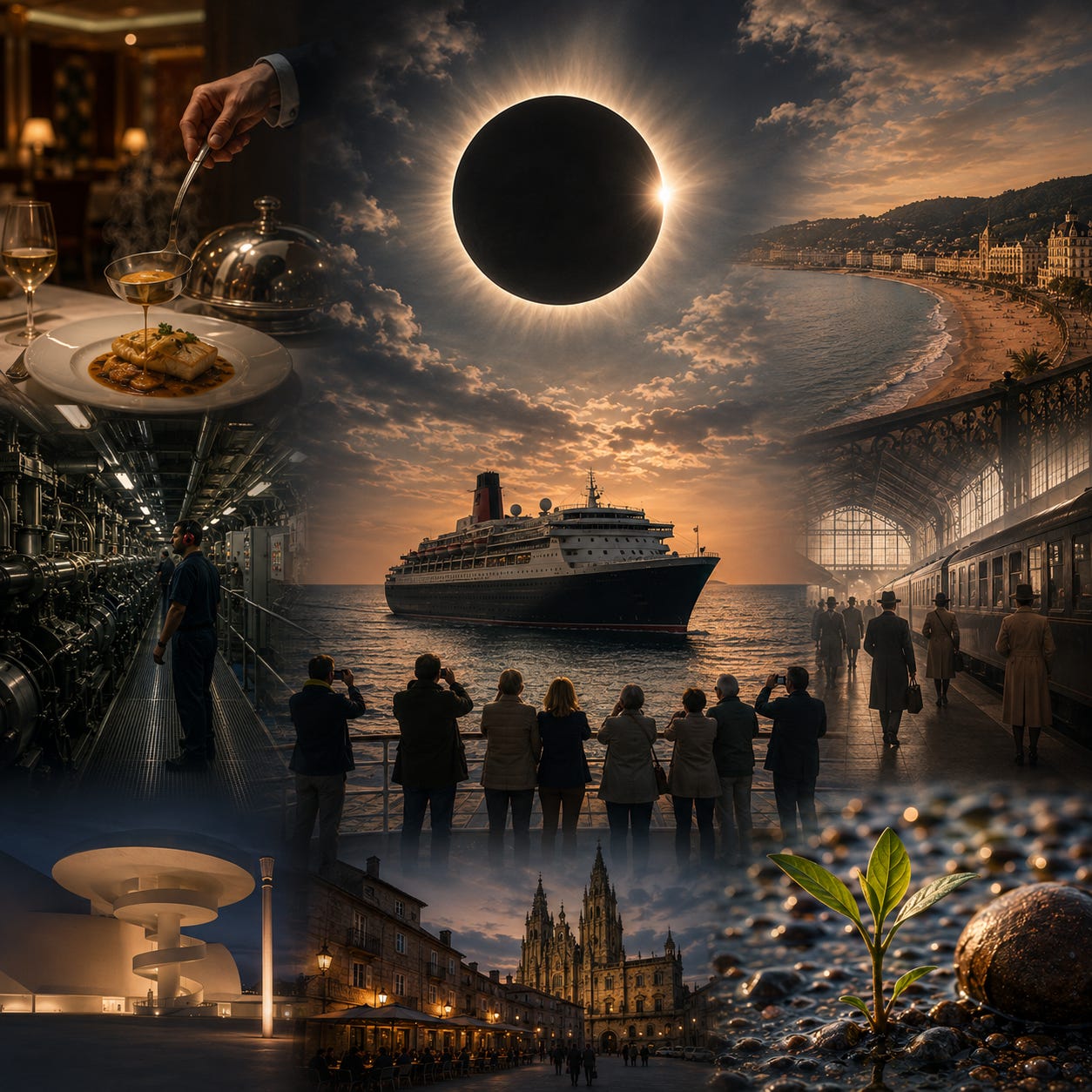
Both White Star and Cunard liners originally departed from Liverpool, but Southampton gradually emerged as an ideal location due to unusually long periods of high water. Together, the two companies form the lineage of what is simply known today as Cunard, with its fleet of “Four Queens”: Queen Mary 2, sometimes described as the last ocean liner, on which I sailed across the Atlantic in 2019, Queen Victoria, Queen Elizabeth, and the young, modern Queen Anne, my home for the week.
Cunard prides itself on maintaining a high standard of service, inspired by the glorious time of Atlantic crossings. Although the three classes familiar to anyone who has seen Titanic are gone, there are still areas reserved for Queens Grill or Princess Grill passengers, who also enjoy slightly more comfortable accommodation. Table-side experiences such as Sole Meunière or Crêpes Suzette are still offered in the Grills, where the cheese platter comes with picturesque “accoutrements.” A dress code is still enforced in the evenings with a little more insistence than on other ships, and Afternoon Tea remains a staple of the so-called White Star service.
Helmed by one of the very few female captains, Queen Anne incorporates the latest technological advances in terms of energy efficiency and waste management. A “behind the scenes” tour on a sea day allowed me to witness once again the challenges involved in providing a safe, smooth and enjoyable voyage to 3,000 passengers and 1,200 crew. The painstakingly detailed logistics at work in the engine room, on the navigation deck, in the restaurants and bars or in the entertainment venues, for example, offered an eye-opening lesson in organisation and coordination.
A first stop in Getxo allowed me to embark on an excursion to the charming seaside city of San Sebastián (Donostia in Basque), with its picturesque sandy beaches and imposing villas, some of them originally built by wealthy English industrialists. The simple pleasure of entering a random store to buy a succulent bocadillo de jamón was enough to make braving the formidable humidity worthwhile.
The next stop, A Coruña, afforded the opportunity to discover Santiago de Compostela, its many pilgrims and delicious almond pastries. The Centro Galego de Arte Contemporánea, beautifully designed by Portuguese architect Álvaro Siza Vieira, offered a riveting retrospective of German artist Alexandra Ranner, whose constructed architectural spaces, vaguely reminiscent of Thomas Demand’s work, came across as strangely oppressive.
The final Spanish stop in Gijón provided the perfect opportunity to discover Centro Niemeyer, a unique arts complex designed by the Brazilian architect Oscar Niemeyer in struggling, post-industrial Avilés. The project was marred by accusations of misappropriation and mismanagement, and the hope of duplicating the “Bilbao effect” has so far failed to materialise. The curvy building, however, remains an awe-inspiring sight. An exhibition by Canadian photographer Edward Burtynsky, who has been documenting humanity’s transformation of natural landscapes, in this instance through its relationship with water, proved fascinating in the tension between its extraordinary aesthetic beauty and something approaching photojournalism.
Finally, a stop in Cherbourg-en-Cotentin felt like a trip back into history. During the golden age of transatlantic travel, Cunard’s great liners, including Queen Mary and Queen Elizabeth, would make a stop in Cherbourg after leaving Southampton on their way to New York, hence the spectacular Art Deco terminal designed by René Levavasseur, also the designer of several prominent buildings in the city centre. An immersive VR experience allows visitors to relive the time when trains ran directly into the terminal, allowing for a mostly seamless transfer to the waiting liner.
At local art outpost Le Point du jour, an exhibition titled Fabriquer un Jardin included ongoing research by Maria Thereza Alves to trace non-indigenous plant species in port cities where cargo ships would unload seed-carrying ballast after empty runs, illustrating the unexpected botanical consequences of maritime trade.
Trains play a central part in Noël Coward’s play Still Life (1936), and an even greater one in David Lean’s unforgettable film adaptation, Brief Encounter (1945), starring Celia Johnson and Trevor Howard. Onboard entertainment included a staging of Emma Rice’s Brief Encounter, a play with music I’d already seen in London in 2008. Unfortunately, Rachmaninoff’s hauntingly romantic music only plays a secondary role, but the inclusion of Coward’s most heartbreaking song, “Mad About the Boy”, was devastatingly effective.
The total solar eclipse on 12 August was the highlight of the week. All passengers were able to observe it under ideal conditions thanks to the ship’s carefully chosen position to chase a clear sky and an open horizon. Additional intellectual fodder had been provided by highly enjoyable conferences, another Cunard hallmark. Talks by Commander Susan Kilrain, who piloted the Space Shuttle on two occasions, and by Dr Elizabeth Cunningham, a Fellow of the Royal Astronomical Society, turned out to be particularly enlightening. Who knew the Moon is gradually moving away from the Earth, meaning that total solar eclipses will cease to exist in roughly 1.2 billion years?
And so, for now, the lights dim… until the next act.