
Monday, August 18th
Paris – The exhibition The Berlin Wall: a World Divided, at the Cité de l’Architecture et du Patrimoine, offered an excellent overview of world history from the 1940s to the 1990s. It traced how the aftermath of the Second World War led to the Cold War, how the polarisation between the Western and Eastern blocs reached its peak, and how this confrontation gradually gave way to an even more complex geopolitical landscape shaped by decolonisation, the rise of the Global South, and international agreements on nuclear non-proliferation.
The museography made inspired use of the galleries’ space and achieved a thoughtful balance between objects, documents, and perspectives, providing ample food for reflection. One section emphasised how art became a tool of propaganda, and particularly the way architecture was used to project competing visions of modernity and progress from both sides of the Wall.
The nuclear arms race was, of course, covered in detail, and I was confronted once again with images of Hiroshima, which seem to be following me lately. One particularly grim detail brought to light was the distribution of “dog tags” to schoolchildren in several U.S. states, mostly during the 1950s, so their bodies could be identified in the event of a nuclear strike.
Tuesday, August 19th
Paris – Saw Snerting (internationally released as Touch), the award-winning 2023 Icelandic film whose plot begins in Iceland and concludes in Japan, with a long sequence in London. The attack on Hiroshima and the fate of the Hibakusha (被爆者), the survivors of the atomic bomb, provide the backbone of the story. What lends the film its warmth and gossamer poignancy, however, is the subtle and luminous performance of Egill Ólafsson (whose career also encompasses numerous ventures into musical theatre, notably as Valjean, Perón and Fred Graham).
Thursday, August 21st
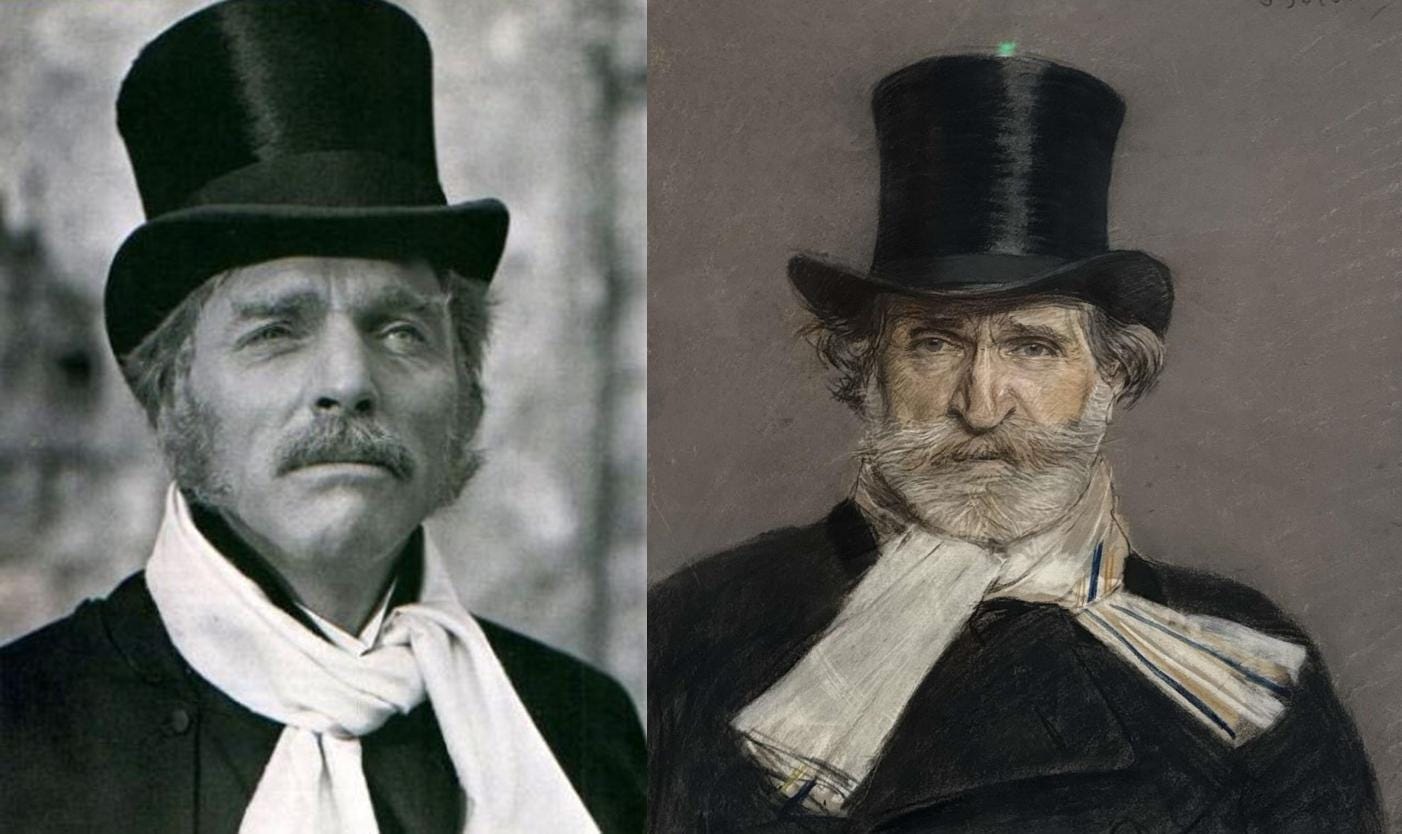
Paris – Finally saw Visconti’s Il gattopardo (1963), arguably one of the greatest films of all time. Not only is it a fascinating portrayal of how a Sicilian noble family navigates the upheavals of the Risorgimento, it is also a work of art, with sweeping panoramas, meticulously composed tableaux, and exquisite cinematography, all heightened by a first-rate Nino Rota score, punctuated by a memorable Giuseppe Verdi waltz.
Burt Lancaster dominates the film with towering authority. His portrayal of the Prince of Salina is magnetic, commanding, and ultimately heart-rending. In the closing frames, it’s hard not to notice how the Prince’s features and garb evoke Giovanni Boldini’s famous portrait of Verdi (which, by coincidence, I had seen only a few weeks before at the Galleria Nazionale d’Arte Moderna in Rome).
“Everything must change for everything to remain the same.” The film’s most famous, and oft-quoted, line is not uttered by the Prince but by his slightly obnoxious nephew, Tancredi, portrayed by a youthful Alain Delon.
Friday, August 22nd
Paris – Made my way to the recently renovated Grand Palais for an exhibition devoted to Niki de Saint Phalle, Jean Tinguely, and Pontus Hultén. Beyond a fine selection of works by Saint Phalle and Tinguely, the exhibition’s chief value lay in how it traced the artists’ close relationship with Hultén, whose contribution to how modern and contemporary art is presented to the public can hardly be overstated.
The exhibition documented Hultén’s decisive role in founding and shaping Stockholm’s Moderna Museet, Paris’s Centre Pompidou, and Basel’s Museum Tinguely, while also charting the landmark exhibitions of Saint Phalle and Tinguely in those institutions. As it happens, I became acquainted with both the Moderna Museet and the Museum Tinguely over the past year, so this exhibition felt like a satisfying wrap-up of sorts.
And so, for now, the lights dim… until the next act.