
Monday 20 October
Cruise Day 9 — Kanazawa
Kanazawa, the capital of Ishikawa Prefecture, was the seat of the Maeda clan, Japan’s second most powerful feudal family after the Tokugawa, during the Edo period (1603–1868). The Maeda were renowned for their patronage of the arts more than for military ambition, a legacy the city still embodies today. Often described as a quieter alternative to Kyoto, Kanazawa has in recent years drawn growing numbers of visitors.
My itinerary centred on two of its major landmarks: Kenrokuen Garden, one of Japan’s “Three Great Gardens” alongside Kōrakuen in Okayama and Kairakuen in Mito; and Kanazawa Castle, its former feudal stronghold. Both offer verdant oases of calm in the heart of the city. Within Kenrokuen, several centuries-old trees are propped up on wooden supports, their shallow roots unable to penetrate the garden’s rocky soil.
Kenrokuen epitomises the philosophy of Japanese garden design, blending fukinsei (asymmetry), shizen (naturalness), wabi-sabi (the beauty of imperfection) and yūgen (subtle mystery). Rocks, water, and trees seem casually scattered, yet form a “structured randomness” that evokes balance and serenity through carefully composed irregularity.
I also admired two remarkable museum buildings — both, unfortunately, closed that day: the 21st Century Museum of Contemporary Art, a 112-metre-wide glass ring designed by the Pritzker Prize-winning duo SANAA (Kazuyo Sejima and Ryue Nishizawa), also creators of the Louvre-Lens; and the D.T. Suzuki Museum, dedicated to the Buddhist philosopher who introduced Zen to the West, set within a serene complex by Yoshio Taniguchi, architect of New York’s MoMA’s 2004 expansion.
Back on board, as I reached the midpoint of Asako Yuzuki’s novel Butter, I looked up Niigata Prefecture, the setting of the chapter I was reading, and realised we were about to sail past it en route from Kanazawa to Sakata.
Tuesday 21 October
Cruise Day 10 – Sakata
My guide for the day was Isabella, a transcultural woman born in Italy, educated in England and resident of Niigata Prefecture (adjacent to Sakata’s Yamagata Prefecture) for more than forty years.
Like other cities along Japan’s northern coast, Sakata prospered during the Edo period thanks to its position on the busy Kitamaebune trade route between Ōsaka and Hokkaidō. The houses of the wealthy Honma family, whose fortune reportedly surpassed that of their feudal lords, still stand as reminders of this golden age, along with spacious riverside warehouses. Today’s reality is much harsher: the depopulation of rural Japan has hit cities along the Sea of Japan coast more severely than elsewhere in the country.
Our first stop was Dewa Sanzan Shrine (“Shrine of the Three Mountains of Dewa”), one of the spiritual centres of Shugendō, an ascetic faith blending Buddhism, Shinto, and Taoist elements. Its practitioners, the Yamabushi, seek transcendence through a strict mountain discipline. The shrine stands on Mount Haguro, one of the “three mountains of Dewa”, about thirty kilometres inland from Sakata.
At the foot of the mountain, a magnificent five-storey pagoda (Gojūnotō), dating from the 14th century, rises among towering, centuries-old cedars. At the top of a 2,446-step stone staircase… or a brief taxi ride away… stands the shrine’s monumental thatched Sanjingōsaiden Hall, with a nearby fire lance ready for instant use.
We then continued to Gyokusen-ji Temple, founded in 1640 by the Honma family. At its heart lies an exquisite “pond-viewing garden” of stone, water, moss and foliage, somewhat reminiscent of Kyoto. The place felt like a haven of serenity, inviting contemplation and introspection.
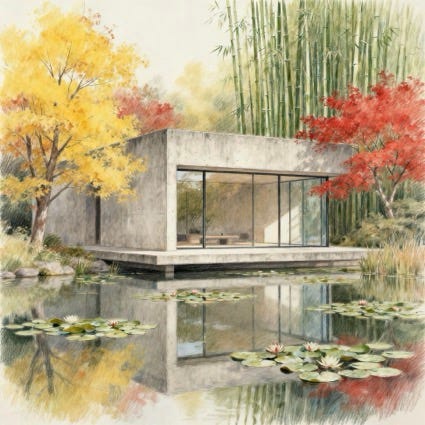
Our final visit was to the Ken Domon Museum of Photography, housed in a sublime building by Yoshio Taniguchi, architect of Kanazawa’s D.T. Suzuki Museum and New York’s Museum of Modern Art extension. Concrete, glass and water compose an oasis of calm and tranquillity.
Ken Domon (1909–1990), a native of Sakata, ranks among Japan’s foremost documentary photographers. On view was a large selection of his work, alongside images by his contemporary Hiroshi Hamaya (1915–1999), who shared Domon’s faith in spontaneous, unposed photography. Domon’s haunting series on the devastation of Hiroshima and Nagasaki left a lasting, bittersweet impression.
Wednesday 22 October
Cruise Day 11 – Hakodate
My local guide, Fumiko, met me at the pier for a tour of Hakodate, Hokkaidō’s third-largest city, visited by Commodore Perry in 1854 after the signing of the Treaty of Kanagawa, which opened several Japanese ports to foreign trade. Hakodate also witnessed the last battle of the Boshin War (1868–69), which sealed the fall of the Tokugawa Shogunate and cemented the Meiji Restoration.
We first took a bus to Goryōkaku Tower, whose 60-metre-high observation deck offers perfect views of the star-shaped Goryōkaku Fort, built in 1864 by the Shogunate to house a Magistrate’s Office asserting its authority over Hokkaidō (then called Ezo). Inspired by European military architecture, especially Vauban’s citadels, most of the buildings were destroyed after the war but the main hall has now been painstakingly restored.
After a short pause at the train station, we boarded another bus to Hakodate’s historic water reservoir (the oldest still in operation in Japan), a good starting point for exploring the Motomachi District. This hillside area flourished during the Meiji era, when foreign consulates and churches were built beside traditional Japanese homes along cobbled streets, in a picturesque meeting of East and West.
We stopped for oshiruko, a sweet red-bean soup with mochi rice cakes, and matcha — though Fumiko, who seemed put off by matcha, opted for coffee. With the ropeway closed for annual maintenance, we hailed a taxi to the top of Mount Hakodate. From its 334-metre summit, the city’s distinctive hourglass shape between two bays unfolded majestically below us.
Our drive dropped us off at the Kanemori Red Brick Warehouses, Meiji-era buildings now filled with shops and cafés. There I succumbed to the intense, bitter flavour of Hokkaidō’s own Royce’s chocolate, before returning to the cruise terminal, grateful to Fumiko for a day richly spent.
Back in my cabin, I watched Yasujirō Ozu’s wonderful 1959 film The Floating Weeds, the story of a traveling Kabuki troupe, and one of his first in colour. Many of Ozu’s trademarks are present: the fixed, tatami-level camera; the frame precisely aligned with the horizontal and vertical lines of the set; the characters’ outward calm even in moments of inner turmoil; and the sparing use of music, reserved mainly for transition shots. I recognised at least two actors from Tokyo Story, which I had watched on my flight a few days earlier.
Thursday 23 October
Cruise Day 12 – Otaru
Once one of Hokkaidō’s major fishing and trading centres, Otaru has retained some of its old-world charm and is today better known as a tourist destination and a gateway to nearby ski resorts.
My group excursion began at the beautifully preserved Aoyama Villa, built at great expense by a family who prospered during the herring-fishing boom at the turn of the 20th century. Constructed from the finest materials and decorated by some of the most celebrated artists of the time, the villa was partly intended to one-up the Honma family residence in Sakata. Its elegantly composed traditional garden adds a touch of serenity to the opulence of the house.
We next took the ropeway up Mount Tengu, whose 532-metre summit offers sweeping views of the city and the Sea of Japan — and transforms into a ski destination in winter. The autumn foliage was just beginning to glow with red and yellow hues, lending extra magic. At the top, locals rubbed the giant nose of the tengu, a long-nosed goblin from Japanese folklore, for good luck.
Back in town, I left the group at the picturesque canal to explore Sakaimachi Street, a lively shopping district that has preserved much of its early-twentieth-century character. Local crafts and confections tempted me at every turn, until I succumbed to coffee and ice-cream at the Kitaichi Hall Café, a high-roofed wooden room softly illuminated by 167 oil lamps.
Friday 24 October
Cruise Day 13 – Aomori
No guide today. I took a taxi to the Aomori Museum of Art, a sleek white building by Jun Aoki (designer of several Louis Vuitton flagships), set on open grounds cut by a deep trench echoing the neighbouring Sannai Maruyama archaeological site.
One of the museum’s highlights is a set of four monumental stage backdrops (9 × 15 metres) painted by Marc Chagall for American Ballet Theatre’s 1942 Aleko, choreographed by Leonide Massine. Not to be confused with Rachmaninoff’s one-act opera with which it shares its inspiration — Pushkin’s The Gypsies —, Massine’s ballet was danced to Tchaikovsky’s Piano Trio in A minor, orchestrated by Ernö Rapée, a version sadly unavailable on record.
Two Aomori-born artists were also prominently featured: Yoshitomo Nara, whose big-headed girls gaze out of the frame with layered ambivalence, and whose giant dog, Aomori Ken, presides over a terrace; and Shikō Munakata, the great 20th century woodblock printmaker who fused traditional technique with a distinctly modern aesthetic.
Next door, the Sannai Maruyama site preserves the remains of a vast Jōmon-period settlement (fourth and third millennia BCE). Alongside tombs, pottery and other everyday objects, its pit dwellings and raised structures mark Japan’s earliest known sedentary culture.
I caught a taxi back to the port and strolled along the waterfront park before re-embarking.
Later in my cabin, I watched Yōjirō Takita’s Departures (2008), winner of the 2009 Academy Award for Best Foreign Language Film. The predictability of the script may have put some viewers off — as may Joe Hisaishi’s somewhat grating pseudo-classical score — yet I succumbed to the charm of this gossamer tale of how paying one’s last respects to the dead may bring closure to the living in more ways than one. The cinematography is simple yet exquisite, the cast brings genuine poignancy to the story… and the migratory Siberian swans reminded me of my day in Sakata, where part of the movie was shot.
Saturday 25 October
Cruise Day 14 – Miyako
Miyako, in the Iwate Prefecture, was the smallest place visited on this voyage. It was severely affected by the earthquake of 2011 and by the ensuing tsunami, despite an elaborate network of sea walls and evacuation routes. Fourteen years later, the houses have been moved uphill, and the sea walls have been strengthened and made higher, demonstrating this small rural community’s determination to rise above adversity.
I met my guide Atsuko at the pier. Our first destination was Jōdogahama Beach, part of the Sanriku Fukkō (Reconstruction) National Park, a place of great natural beauty nestled between limestone cliffs and volcanic rocks jutting from the bay like teeth.
We then drove to Tarō, where the half-destroyed Kankō Hotel serves as a reminder of the violence of the tsunami — despite the sea walls, its first two floors were scraped off by the waves, leaving the top part of the building untouched. It’s in Tarō that I was told about the saying 津波てんでんこ, or tsunami tendenko, meaning “in case of a tsunami, save yourself” — instead of trying to save others, one of the leading causes of deaths in such circumstances.
We continued our exploration of natural beauty at Unosū Cliff, and later at Kitayamazaki Cliff, where we stopped for a bowl of udon noodles topped with local seafood. Located to the north of Miyako, both sites are part of the Sanriku Fukkō National Park and feature 200 metre-high cliffs where cormorants and ospreys come to nest. We equipped ourselves with bells to fend off bears if needs be.
That should have been the extent of the day, but Atsuko remembered a striking modernist building in the neighbouring village of Tanohata. Designed by Takayuki Hozumi and completed in 1974, the Tanohata Junior High School Boarding House, now sadly disused, stands as a vibrant homage to brutalist, or so-called Metabolist, architecture — a distant cousin, so to speak, of Tōkyō’s Nakagin Capsule Tower.
I could tell Atsuko, who approached the building with a certain reluctance, soon fell under its spell. The day — and, to some extent, the trip — couldn’t have ended on a more heartfelt note.
Back on the ship, I watched the film Paddington (2014), recommended by Miyo, my first guide in Kōchi ten days earlier, as a way to symbolically loop the loop — and to reconnect to the Western world — before our last day at sea.
Sunday 26 October
Cruise Day 15 – At Sea
Not a bad day to watch Akira Kurosawa’s Dreams (1990), a collection of eight oneiric vignettes dwelling on the filmmaker’s traumas, fears and hopes. Each short feature is bathed in a specific atmosphere attuned to its mood. Takao Saitō’s cinematography seems to draw its inspiration from Hieronymus Bosch’s The Garden of Earthly Delights.
And so, for now, the lights dim… until the next act.