
Saturday 11 July
To Zurich by plane
Zurich, Opernhaus • Built around the ambiguous contrast between carnality and supposedly pure, poetic love, Tannhäuser isn’t an easy piece to warm up to. This stylised production by Thorleifur Örn Arnarsson didn’t help, intent as it seemed on hitting the dramatic nail squarely on its head rather than giving the plot space to breathe. Wagner’s voice hadn’t yet reached its glorious and revolutionary maturity by 1845. Despite the obvious care he brought to his conducting, Tugan Sokhiev seemed to drag the score back to a conventional Romanticism instead of showcasing its revolutionary traits. The cast provided strong performances, dominated by Christian Gerhaher’s transfixing Wolfram.
Sunday 12 July
Back to Paris by plane
Monday 13 July
Paris, Opéra-Bastille • What if Violetta Valéry were an influencer, monetising her image on social media? That’s the convincing premise behind Simon Stone’s take on La Traviata, the ultimate tale of “love cannot stop death.” The two giant screens came close to dwarfing the human drama; fortunately, the set designer also created a tech-free space that needed only a spin of the — incredibly noisy — turntable to emerge. The cast and orchestra performed dutifully under Marta Gardolińska’s guidance, but there was no escaping a slight feeling of routine. Perhaps that was inevitable: it was, after all, the last performance of the season, and the heat outside was excruciating.
Tuesday 14 July
To Basel by train
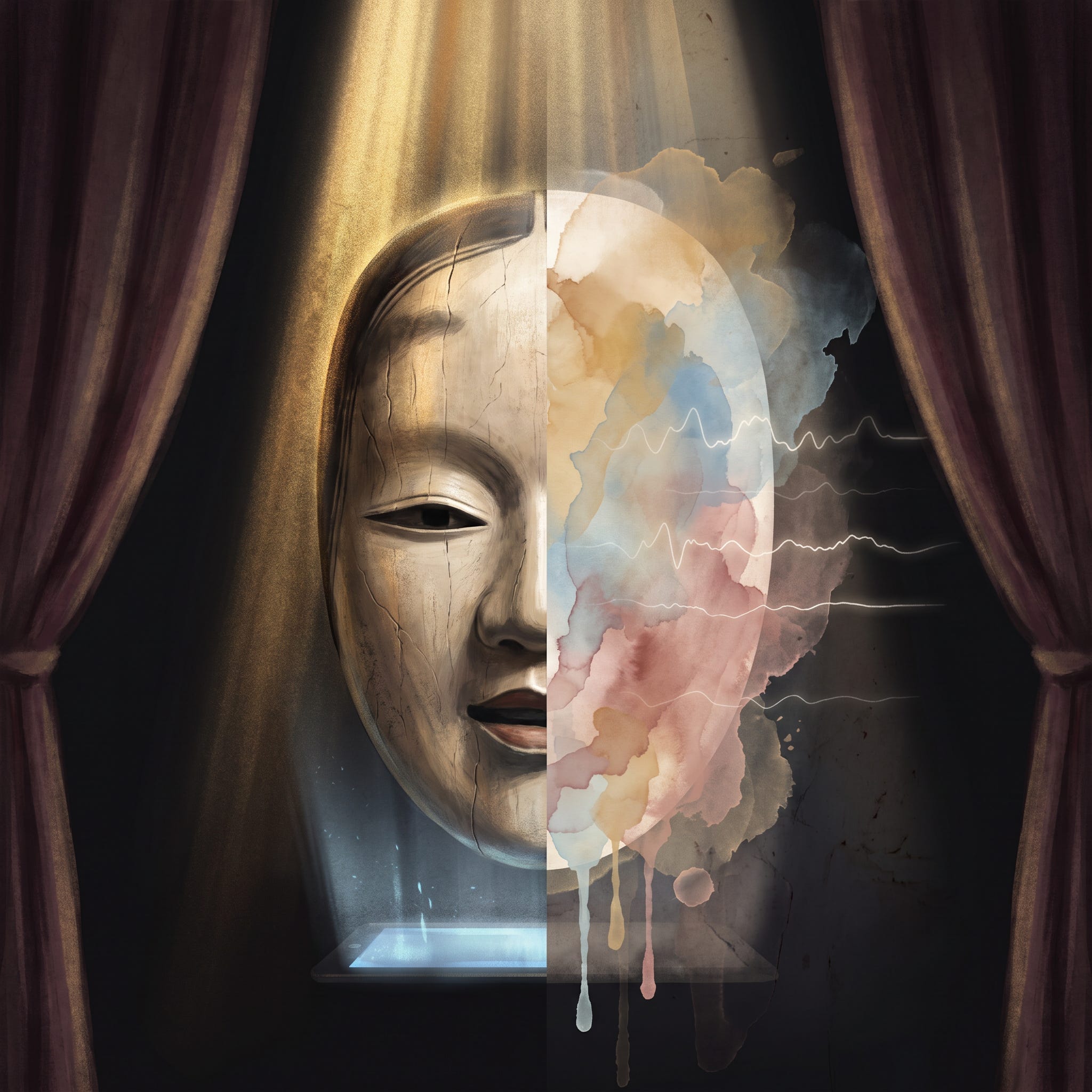
Riehen (Basel), Fondation Beyeler • I harbour mixed feelings about art that requires explanations before it can be fully appreciated, and Pierre Huyghe certainly falls into that category. Had I not grabbed the visitor’s booklet at the entrance of this exhibition, I would have missed a significant portion of it. Having made that effort, I felt invigorated by the open questions Huyghe’s art raised, like a series of provocative philosophical essays. As always when that happens, I felt giddy when I realised that I had already seen Untitled (Human Mask), a film about a macaque wearing an eerily lifelike Noh-style girl’s mask and wandering through an empty restaurant in Fukushima.
Basel, Kunstmuseum • Helen Frankenthaler belonged to that post-war generation of American artists who opened up possibilities by rethinking art as a manifestation of inner urges and impulses rather than theorising about technique or subject matter. This retrospective was an eye-opener: if I had already crossed paths with Frankenthaler’s work, I had almost no recollection of it. The evolution of her treatment of colour and texture proved a fascinating discovery. For some reason, I was particularly drawn to the works inspired by older masterpieces, like Monet’s Water Lilies — an approach similar to Gerhard Richter’s engagement with Titian’s Annunciation.
Back to Paris by train
Wednesday 15 July
Paris, Théâtre Rive Gauche • As the audience was waiting for the curtain to go up on the musical Paris is Magique, a few bars of cutesy musette accordion played over the auditorium’s loudspeakers in an endless loop. The first couple of times were cute; the rest was torture, an apt introduction for a show probably aimed at tourists — as the English and Japanese-language supertitles might suggest — mixing first-, second-, and third-degree humour with unrestrained randomness. The canned music and audience participation were painful; the revue postures and silhouettes seemed to imply that at least part of the cast came from the dying world of Lido-like shows; a microphone incident and the frequently out-of-sync supertitles brought me back to the thankfully bygone time when no French production could go without technical issues. I had a hard time getting my head around the fact that a scene clearly written to get the audience back in the mood after an intermission was performed despite the lack of one. There were, however, a few pleasant scenes… but none so satisfying as when one of the performers started playing the trumpet live.
Thursday 16 July
Paris, UGC Maillot • Though it wears its Hitchcockian influences on its sleeve — not least because of its Bernard Herrmann score arranged by Elmer Bernstein — Martin Scorsese’s Cape Fear (1991) is one of those movies in which the director’s hand is ever-present, with the camera constantly drawing attention to itself through frantic movements. The Swatch Twinphone in Danielle’s bedroom or Kersek’s cocktails of Jim Beam bourbon and Pepto-Bismol are delicious period details. Touchingly, Scorsese invited Robert Mitchum and Gregory Peck, the two male stars of the 1962 Cape Fear, to appear in small roles. The encounter between Robert De Niro and Juliette Lewis, rich in sexual innuendos, in the fairy-tale setting of an empty theatre is perhaps the most intense scene. At one point, De Niro, almost singing, says “I think we’re alone now” — the title of a Tommy James song whose opening lines seem eerily appropriate: “Children behave / That’s what they say when we’re together / And watch how you play / They don’t understand.”
Friday 17 July
Paris, Bourse de Commerce Pinault • A guided tour of a few select works from the current exhibition, Clair-Obscur, was a fitting wrap-up to the week. One of the highlights was coming across Pierre Huyghe’s Mind’s Eye (L), a cousin to Mind’s Eye (FL), which I’d seen three days earlier at Fondation Beyeler. The two sculptures, inspired by recordings of brain waves, are designed to evolve under the viewer’s eyes, but that movement is far too slow to be noticeable.
And so, for now, the lights dim… until the next act.