
Saturday 27 June
To London by train
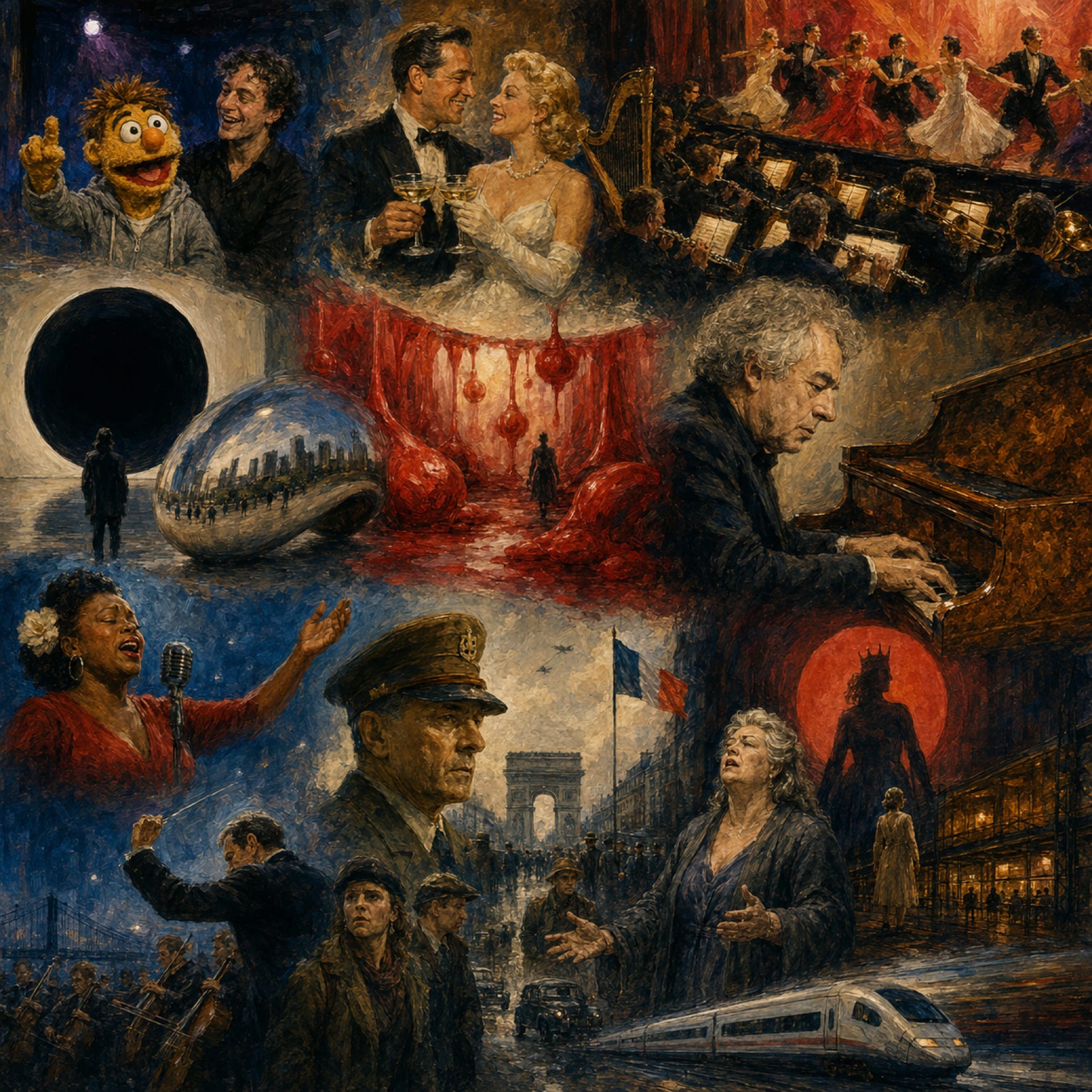
London, Shaftesbury Theatre • “It gets old,” the character based on Gary Coleman told the audience after being introduced. Maybe it does, but Avenue Q still holds its ground pretty well after nearly 25 years. So what if a line had to be added to explain that a mixtape worked pretty much like a playlist. This production at the Shaftesbury Theatre (soon to be renamed the Judi Dench) made me long for the time when irreverence and a crazy imagination were the driving forces behind new Broadway musicals. Avenue Q is smart, sharp, and doesn’t feel it has to soften its edges — because at its core, it’s a lesson in kindness and sweet melancholy. I’ll always be grateful to that show for introducing me to the concept of Schadenfreude and for making “purpose” a code word for my friend É. and me.
London, Barbican Theatre • Choosing High Society might seem a tad risky to continue the Barbican’s seemingly endless Summer series of Cole Porter musicals: adapted many years after Charles Walters’s 1956 film, it has always been considered a flimsy property and has never, to my knowledge, been presented to the public twice in the exact same form, drawing more or less liberally from the Cole Porter catalogue. I enjoyed the production a lot more than I expected in spite of its bulky unit set and the sense that each scene was frantically eager to segue into the next big musical number, performed with almost manic energy. There are worse ways to stage Cole Porter, though — as last year’s Kiss Me, Kate! clearly demonstrated — so there was a good opportunity to appreciate the sophisticated score, witty lyrics, and committed cast — with a special mention for the utterly charming Julian Ovenden. The reduced orchestrations worked best when they stayed away from the over-amplified string section and relied on flute and harp… not forgetting a strong brass section, a recurring staple of British pit bands.
Sunday 28 June
London, Hayward Gallery • Anish Kapoor’s use of the pigment Vantablack, which absorbs almost all light, defied perceptions of depth and relief and reminded me of what James Turrell achieves, paradoxically, with light. Contemporary art often leads us to question whether things are as they seem, a question Kapoor also raises with his large-scale mirrored steel structures on the terraces of the Hayward Gallery, which distort, invert and disorient. The colour red dominated the rest of the exhibition, turning religious sacrifices, bloody human viscera and overinflated blobs into a strangely compelling visual continuum.
London, The Other Palace • The musical Hot Mess might sound a little too clever for its own sake, staging the love story and eventual separation between Earth and Hugh Mankind (say it aloud). It would be easy for such an allegory to turn out preachy or awkward. And yet, the lightness of touch and carefully calibrated goofiness that writer Jack Godfrey brought to it made for an unexpectedly enjoyable performance, while allowing the protagonists to find a reassuringly happy ending despite going their separate ways. Maybe there’s hope after all.
Back to Paris by train
Monday 29 June
Paris, Théâtre des Champs-Élysées • András Schiff insists that his only motivation is to look deep into a composer’s soul. And yet, for this all-Schubert recital, he once again designed a programme that was unmistakably his own, both in its structure — grouping works into uninterrupted sequences — and in its serious, methodical — some might say dry — approach to interpretation. Not to mention his piano, clad in what looked like gleaming walnut burl.
Tuesday 30 June
Paris, Théâtre des Champs-Élysées • A few days after this joyous performance of Porgy & Bess by the Orchestre Lamoureux under Quentin Hindley with the Ensemble vocal Voix d’Outre-mer, I was still humming — no, singing — “Oh Lawd, I'm On My Way” at every opportunity. Mounting this show is a formidable endeavour, but the effort paid off. Syncopation doesn’t always come naturally to French performers, yet here the orchestra and cast often seemed to be swinging together with remarkable abandon. Playing Maria, Axelle Saint-Cirel was immediately recognisable as the mezzo-soprano whose rendition of La Marseillaise from the roof of the Grand Palais became one of the defining images of the opening ceremony of the 2024 Paris Olympics.
Thursday 2 July
Paris, UGC Maillot • I experienced a slight sense of déjà-vu in Antonin Baudry’s J’écris ton nom, the second instalment of La Bataille De Gaulle — the truth-or-dare dealings with the British and the Americans, the courageous war hero leading his men into a seemingly hopeless battle, the everyday people behind the Résistance, the finely calibrated soundtrack. Yet I easily let myself be drawn into this meticulously crafted movie, captivated by its inspirational scale, seduced by its cast, and charmed by its deftly timed humour.
Friday 3 July
To Aix-en-Provence by train
Aix-en-Provence, Grand Théâtre de Provence • I hadn’t seen Nina Stemme since her Kostelnička in Stockholm in 2024. Her towering presence as the Amme in Barrie Kosky’s production of Die Frau ohne Schatten for the Aix-en-Provence Festival confirmed how well she is suited to those formidable maternal figures whose seemingly good intentions trigger tragic consequences. The performance also marked Klaus Mäkelä’s debut in an opera pit. Together with the Orchestre de Paris and a fine vocal cast, he infused iron-hot intensity into a score which oscillates between the rawness of Salome and the charm of Der Rosenkavalier. Kosky managed to bring out the philosophical poetry of the piece without hammering the “get a child to validate your life” message, which has not aged well. I was amazed by several set pieces, including a dye shop which looked as though it could have been Fagin’s hideout in Oliver Twist.
Transportation challenges meant that I was only able to attend Acts II and III.
And so, for now, the lights dim… until the next act.