
Saturday 10 October
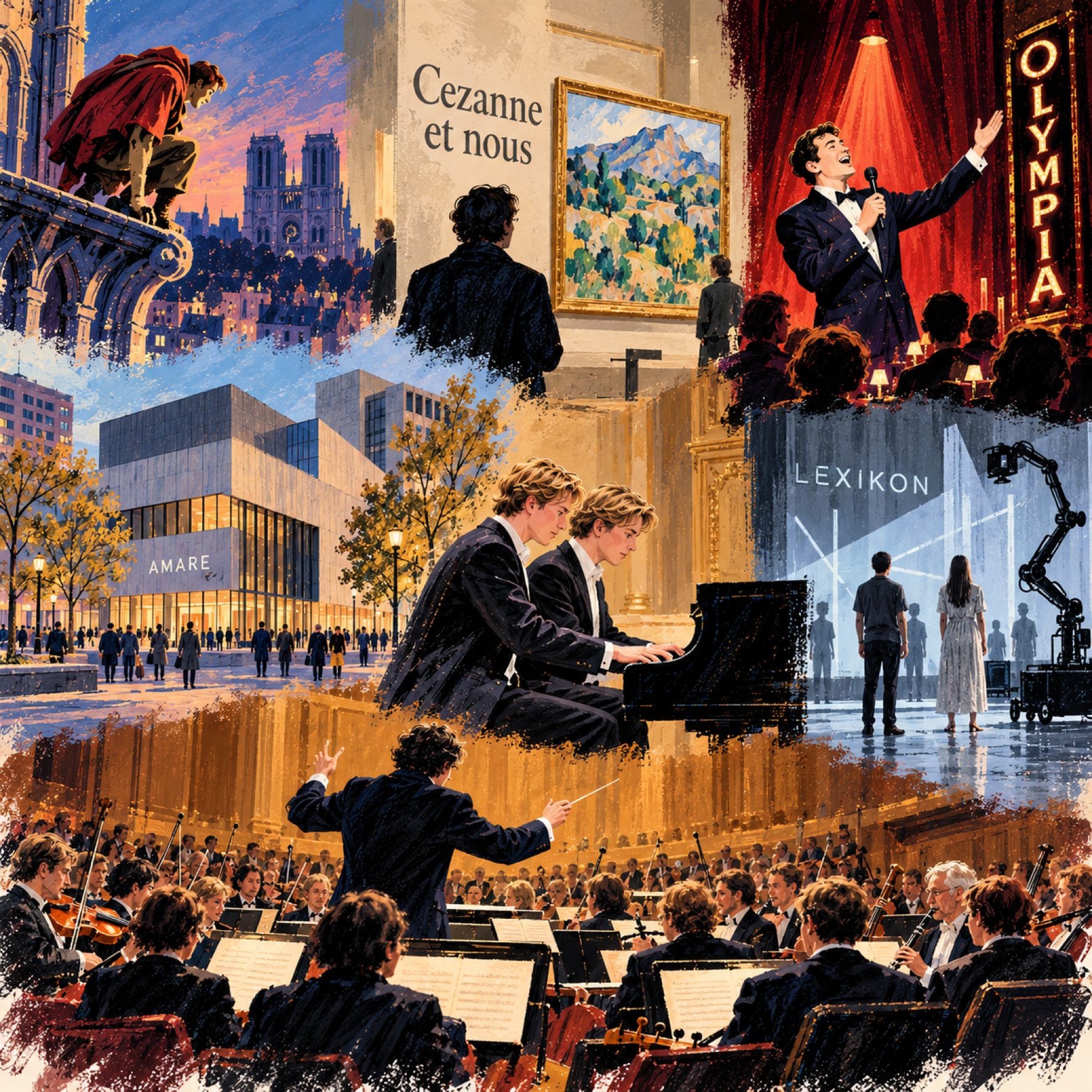
Paris, Studio Marigny • Le Bossu de Notre-Dame, a small musical evidently targeting children, provided some light fun but committed the cardinal sin of using prerecorded music. Some of the jokes were clearly aimed above the children’s heads, a welcome acknowledgement that adults might also be in attendance.
Paris, Grand-Palais • The Cezanne et nous exhibition didn’t fully convince in its attempt to install Cezanne as “an artist’s artist” by juxtaposing his art with that of contemporaries or successors. The choice to remove the accent on the painter’s name turned out to be one of the most interesting aspects.
Paris, Théâtre du Funambule • In Mémoire(s) de l’Olympia, Tito Clément spoke lovingly about the mythical Paris music-hall while paying homage to some of its most renowned artists in song. The show warmed my heart because it believed in the evocative power of theatre no matter how small the scale. The use of lighting was particularly effective.
Paris, Philharmonie de Paris • For their second Paris concert, the New York Philharmonic under Gustavo Dudamel offered a programme that played to the orchestra’s natural strengths. John Adams’s On the Transmigration of Souls sounded as heartbreaking as on my well-worn CD while Prokofiev’s Symphony No. 5 benefited from an undercurrent of formidable collective energy.
Sunday 11 October
The Hague, Amare • Opened just five years ago, Amare was born of a remarkable ambition: to build a modern, multi-purpose venue housing various arts companies, with a welcoming concert hall as its core. The trip to The Hague proved somewhat more challenging than I expected, but I managed to make it on time. The Residentie Orkest under Jun Märkl offered a programme combining Tchaikovsky’s Violin Concerto (with Stefan Jackiw) and Richard Strauss’s Ein Heldenleben. I found the listening experience a little uncomfortable, due to a combination of slightly “metallic” acoustics and the orchestra’s tendency to play a little too loud, but I was glad to discover such an interesting venue.
Monday 12 October
Paris, Théâtre des Champs-Élysées • Lucas and Arthur Jussen aren’t the superstars in France they are back home in the Netherlands, but their recital at the Théâtre des Champs-Élysées got an enthusiastic, well-deserved reception. The eclectic programme ranged from Bach to contemporary music, highlighting the brothers’ ability to imprint a very personal mark on each piece. As their last encore, the Jussens paid tribute to their grandfather Jus Jussen, a well-known Schlager singer in his time, by playing (and singing!) his greatest hit, Julia.
Wednesday 14 October
Paris, Ateliers Berthier (Théâtre de l’Odéon) • El Conde de Torrefiel’s Lexikon turned out to be an unexpectedly engaging theatrical experience. Presented as an experiment on language, it appeared at least as much a challenge of traditional performance conventions, using lights, recordings, choreography — and robotic equipment — to question the very vocabulary of theatre. The actors frequently appeared with their backs to the audience, further subverting expectations.
Thursday 15 October
Paris, Philharmonie de Paris • This unusual concert by the Orchestre de Paris under Esa-Pekka Salonen featured Bertrand Chamayou tackling both of Ravel’s Piano Concertos. Not only was the endeavour remarkable, it was also a resounding success, with Chamayou owning every note with unquestionable authority. The almost-too-rich concert opened with the premiere of a catchy piece by contemporary American composer Gabriella Smith and closed with an electric rendition of Bartók’s The Miraculous Mandarin, in which the orchestra seemed to be dancing along in sheer bliss. The evening was made all the more emotional by the retirement of legendary clarinettist Pascal Moraguès after 45 years with the orchestra.