
Saturday 28 February
Neil Simon Theatre, New York • After avoiding it for over four years, I eventually gave in and attended MJ the Musical, the show retracing Michael Jackson’s rise to universal stardom — and carefully avoiding all touchy areas. There’s no denying the extent of the theatrical craft involved and the sheer drive and scale of most musical numbers; however, I found myself desperately looking for some missing dramatic crux in the otherwise insipid book. The show ended on a visual high with the recreation of the “Thriller” music video, which also felt like a confirmation of its dramatic shortcomings.
Nederlander Theatre, New York • All Out, a series of skits written by Simon Rich, a comedy writer known for his contributions to Saturday Night Live, The Simpsons, and The New Yorker, turned out to be a mixed experience. The material used was uneven, to say the least, and the only piece I found worthy of a Broadway stage was the very last, titled “The City Speaks.” What made the show bearable in the end was a combination of a short duration, a great (rotating) cast, Alex Timbers’ inventive staging… and the powerful musical vignettes provided by soul-pop band Lawrence.
Marjorie S. Deane Little Theater, New York • David Shire and Richard Maltby, Jr., two of the last survivors of Broadway’s second Golden Age, are widely recognised as masters of the revue form, having provided two staples of the repertoire with Starting Here, Starting Now (1976) and Closer Than Ever (1989). This new show, titled About Time and conceived as the third part of the trilogy, was a wonderful testament to their combined storytelling talents. The first-rate cast took an evident delight in giving life to stories of life, age, and experience… the perfect way to close a loop half a century in the making.
Sunday 1 March
Back to Paris by plane
Wednesday 4 March
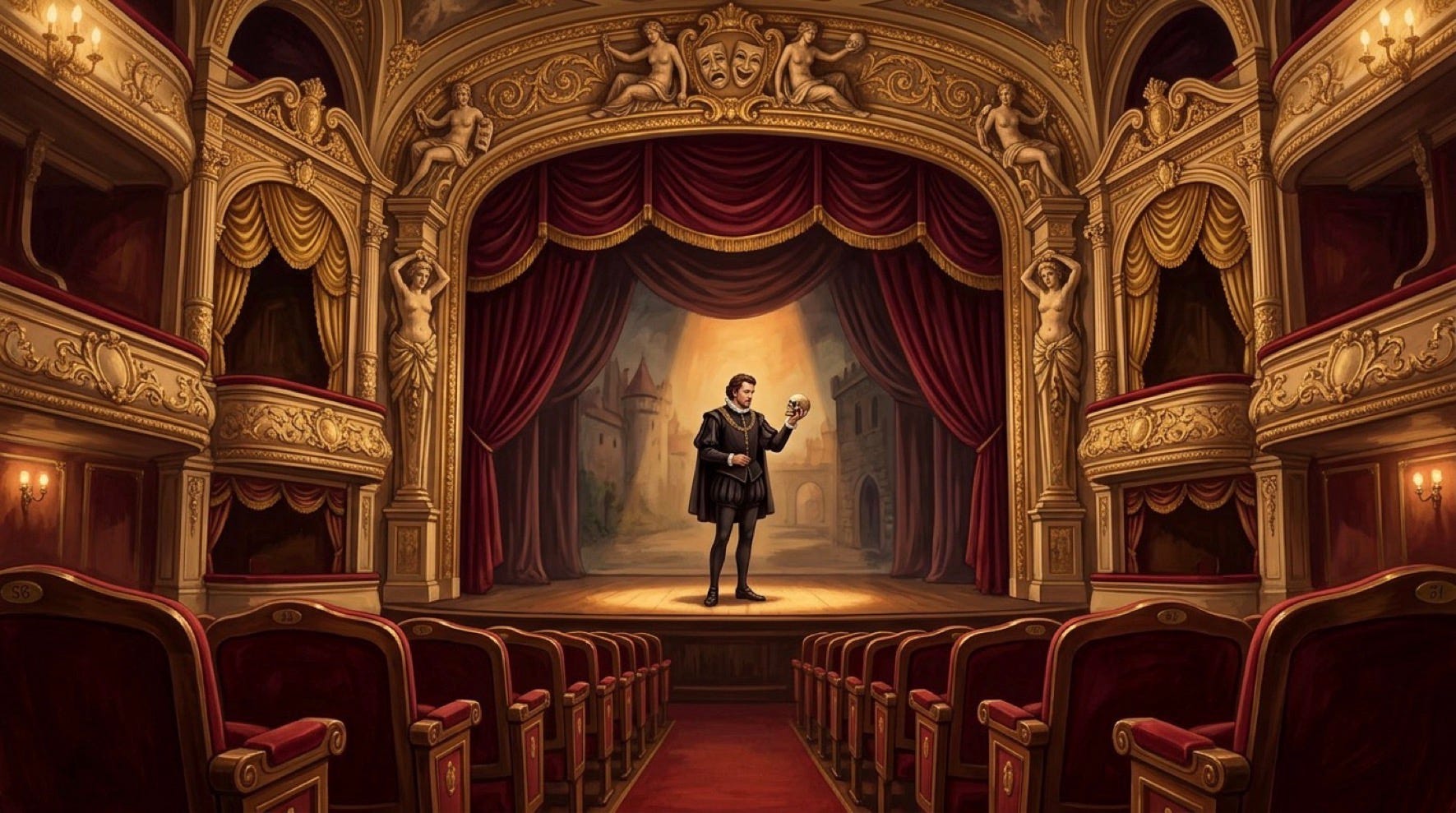
Paris, Théâtre de l’Odéon • Ivo van Hove gave Hamlet his customary feverish treatment, relying on a new, high-energy French-language translation, a bare stage where some intricately designed curtains provided spatial delimitations when needed, and several of the most exciting members of the Comédie-Française troupe — temporarily exiled from its base during renovation works — who provided a high-octane reading amplified to the rafters by aggressive sound design. One could argue that Hamlet doesn’t need such a deployment of all-out dramatics, but the experience certainly gave the tragedy some captivating relief.
Thursday 5 March
To Chicago by plane
Chicago, Chicago Shakespeare Theater • I haven’t read Maggie O’Farrell’s Hamnet, a novel given parallel silver screen and stage adaptations, the latter by Lolita Chakrabarti for the Royal Shakespeare Company. This US transplant at Chicago Shakespeare Theater had me wonder what previous audiences found in this slow-moving, melodramatic play whose substance seemed concentrated in its last moments, when Anne Hathaway — renamed Agnes — realised how her husband William Shakespeare had used the death of their son Hamnet in writing Hamlet. I couldn’t tell what annoyed me most: the set’s continuous but useless metamorphoses or the pedestrian dramatics of the play.
Friday 6 March
Chicago, Symphony Center • In a concert that illustrated the exciting potential of their future working relationship, Klaus Mäkelä led the Chicago Symphony Orchestra in a chronologically, stylistically and geographically coherent programme bringing together Darius Milhaud’s Le Bœuf sur le toit (1920), Gershwin’s An American in Paris (1928) and Stravinsky’s The Rite of Spring (1913). While the Milhaud felt somewhat repetitive and the Gershwin a tad stiff and breathless, The Rite of Spring had the orchestra playing with electrifying intensity, the collective display of energy somewhat dulled by the hall’s acoustics.
And so, for now, the lights dim… until the next act.