
Saturday 21 February
To Vienna by plane
Musikverein, Vienna – Andris Nelsons led the Wiener Philharmoniker in Bartók’s Piano Concerto No. 3 — played with surprising emotional restraint by Lang Lang — and Mahler’s Symphony No. 1, whose Austrian premiere in 1900 was conducted by the composer himself. Despite the orchestra’s unmistakable sheen, a certain routineness crept into the performance. Nelsons nevertheless drove the symphony to its triumphant apotheosis with his usual theatrical flair.
Baden bei Wien, Stadttheater – I took the opportunity to see an Austrian production of The Sound of Music in a theatre known for respecting its musical theatre repertoire. The experience was everything it ought to be: genuine and warm, the orchestra and cast performing the show exactly as written. Although I don’t speak German, I could sense that the translation sat comfortably on the music. Apart from a puzzling choice in the last scene — Rolf remained frozen in the convent’s graveyard, as if contemplating joining the family on their trek across the Alps — the production handled the frequent scene changes deftly, despite an obviously limited budget. After the curtain calls, sing-along reprises of the show’s most famous songs added to the evening’s enjoyment. The actors playing Nazi characters had removed their swastikas before taking their bows — a welcome demonstration of sensitivity.
Sunday 22 February
Konzerthaus, Vienna • At the helm of the Wiener Symphoniker, Lorenzo Viotti conducted a riveting reading of Shostakovich’s Symphony No. 7, which sustained its monumental scale without sacrificing emotional urgency. The only questionable choice was to open the programme with an orchestrated version of Bach’s Chaconne from Partita No. 2, which, despite a luxuriant orchestral palette, felt superfluous. There was no trace of routine in an interpretation that never once relinquished its tension or sense of direction.
Back to Paris by plane
Monday 23 February
Paris, Théâtre des Abbesses • Spanish dancer and choreographer María Muñoz has enjoyed a long relationship with Bach’s The Well-Tempered Clavier. She was about to retire it when an offer came to reïmagine the work — originally conceived as a solo — into a family affair involving her husband and three children. I let myself be drawn into a world of organic, at times almost animal, movements. The apex came when all five performers, after a series of solos, merged fluidly into what looked like a single, breathing organism. Glenn Gould’s huffing and puffing — particularly evident through the theatre’s sound system — added yet another living presence to the tableau.
Tuesday 24 February
Paris, Palais-Garnier • With Eugène Onéguine, Ralph Fiennes made an unconvincing operatic directing debut. He designed images that looked either derivative (Act I felt like a pale echo of Robert Carsen’s brilliant staging) or misguided: the black costumes in Act III, the strict separation of men and women at both balls, and a clumsy reference to Pushkin’s bear during the Gremin ball, oddly reminiscent of the Radio City Christmas Spectacular’s Nutcracker sequence. Fortunately, Fiennes worked with a solid cast and orchestra. Yet I found myself, unusually, almost hoping for a disturbance that might force a concert version — hardly an unprecedented occurrence at the Paris Opera.
Wednesday 25 February
Paris, Philharmonie • Ukrainian conductor Oksana Lyniv led the Orchestre de Paris in a lyrical programme culminating in a spacious account of Dvořák’s Symphony No. 8, which filled the hall with glowing harmonies and generous phrasing. Unfortunately, it was preceded by a largely misguided account of Sibelius’s Violin Concerto by Bomsori Kim, a young Korean violinist whose episodic interpretation lacked a sustained arc. Two contemporary works opened the evening: one of Joan Tower’s Fanfares for the Uncommon Woman — the third for me this season — and Eduard Resatsch’s Les Visions du prince. Resatsch, also from Ukraine, drew inspiration from Saint-Exupéry’s Le Petit Prince to craft a layered piece full of internal tensions, sustaining attention through its varied and richly sculpted orchestration.
Thursday 26 February
To Washington DC by plane
Washington DC, Arena Stage – I’ve never subscribed to the common wisdom that considers Pal Joey a “problem show” because of its unlikeable title character — especially given its glorious Rodgers & Hart score. Arena Stage thought they solved this questionable issue by extensively rewriting the show and retitling it Chez Joey, the name of the nightclub Joey Evans runs in Act 2. The result was such a mess that I took the unusual — and painful — decision to leave at intermission despite flying across the Atlantic for this performance. In this reïmagined version, Joey behaved like a discombobulated puppet, while the other characters — seemingly permanently wired — could not utter a line without stomping a foot or tapping it out for emphasis. The score often distorted the melodies beyond recognition and interpolated songs from other shows, including “Sing for Your Supper,” which should have remained where it belongs — in Syracuse. The onstage band frequently drowned the actors’ voices. Heavy on drums and tripled brass, the orchestrations failed to achieve the light, jazzy touch they seemed to aim for and instead contributed to an atmosphere of relentless, almost manic frenzy. Paradoxically, this production made the case that Pal Joey is indeed a problem show — when staged with little regard to its integrity.
Friday 27 February
To New York by plane
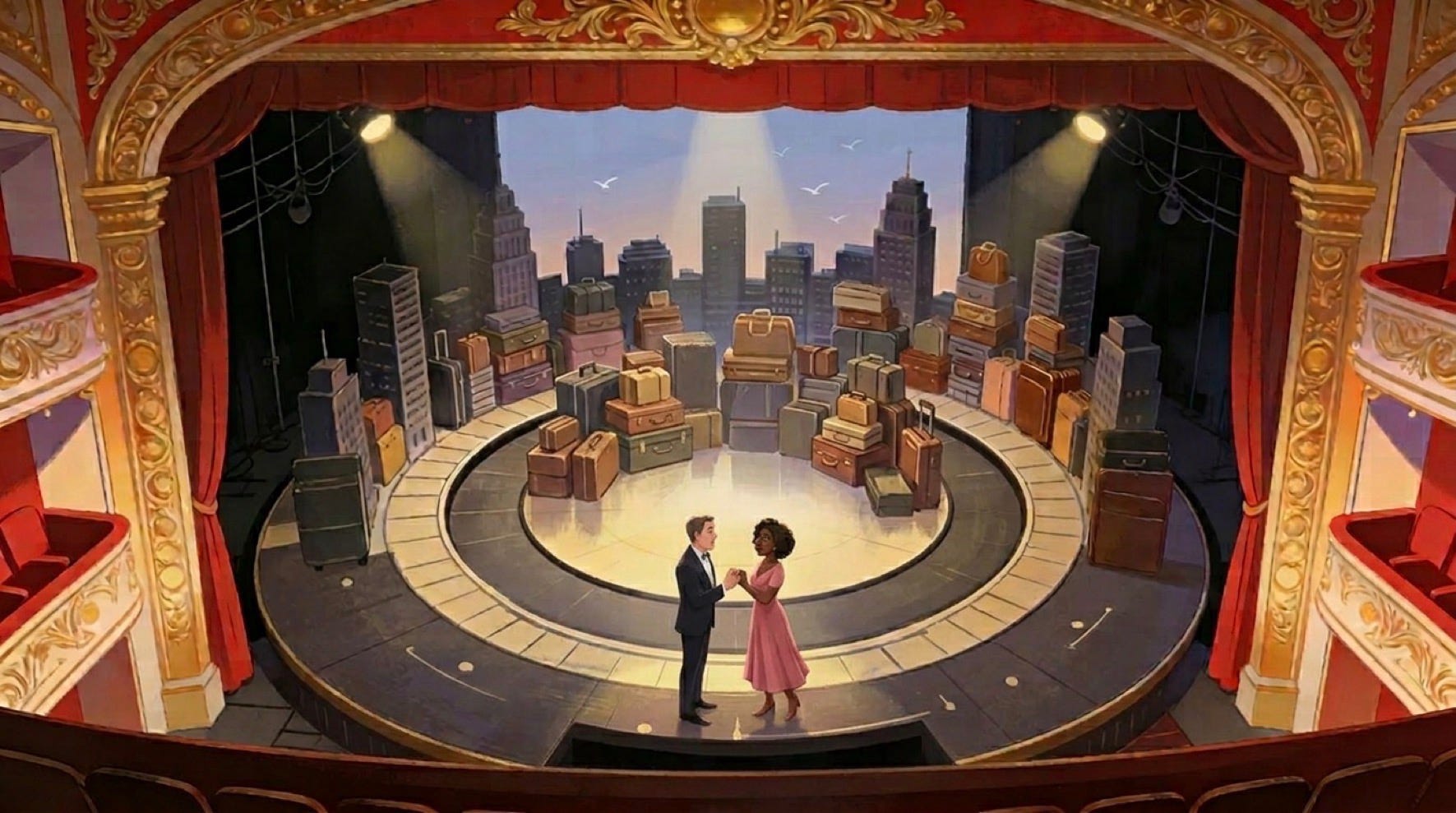
New York, Longacre Theatre • Having missed it in London, I finally caught the British musical Two Strangers (Carry a Cake Across New York) on the Great White Way. In spite of a few plot holes and a strange choice of accent for the male protagonist, a supposed lower-middle-class Basingstoke lad, I found the performance fresh and winning. Besides Soutra Gilmour’s nifty set design, the show’s charm rested largely on its two performers, and I was particularly touched by Sam Tutty, the West End’s original Evan Hansen. It was hardly a perfect show, but one that gave hope that there might still be a place on the world’s stages for good old musical comedy — “the two most glorious words in the English language,” as all musical lovers know. If anything, Two Strangers made me want to follow its authors, Jim Barne & Kit Buchan — who, the programme informs us, have a combined height of 12’6”.
And so, for now, the lights dim… until the next act.