
Saturday 30 August
To Chichester by train. Chichester Festival’s big musical for 2025 was Top Hat, the stage adaptation of the classic 1935 Fred Astaire & Ginger Rogers film, which premiered in Milton Keynes in 2011, where I was lucky to catch it.
The paper-thin book was weighed down by some of the clumsiest one-liners imaginable. Staging and choreography by Broadway veteran Kathleen Marshall felt a touch derivative. The comic turns overshadowed the leads, and I couldn’t help recalling Tim Flavin’s effortless charm when he glided across the stage in the original West End production. The sound design, as so often these days, lent a metallic edge to the music, and hardly did justice to Irving Berlin’s magnificent score, despite competent playing by the orchestra.
And yet the overall experience never quite sank to the level the individual shortcomings might suggest. Because, you know… Irving Berlin.
Sunday 31 August
To Salzburg by car, plane and train. The opportunity to listen again to Kirill Petrenko’s and the Berliner Philharmoniker’s take on Mahler’s Symphony No. 9 at the Salzburg Festival was irresistible, even if it implied a full day of travel. I’d been awestruck by Petrenko’s intensely organic interpretation in Amsterdam during the Mahler Festival a few months earlier, and was eager to experience it once again.
I was not disappointed. Petrenko brought vivid relief to Mahler’s extraordinary score, whether in the self-reflective, pathos-laden slow movements or in the expressive, almost expressionist central movements — which assumed a Shostakovichian character with their complex layerings and strident high notes. He elicited beautiful performances: with all soloists at white heat, the orchestra never lost its sense of shared purpose.
When, two thirds into the Rondo-Burleske, the trumpet played the deeply emotive “turn” that seems to come out of nowhere and foreshadows the obsessive motif of the Adagio, it became clear the evening was headed to a sublime, light-bathed finale.
Monday 1 September
Back in Paris. Re-read James Thurber’s The Secret Life of Walter Mitty, the short story that first appeared in The New Yorker in 1939. It’s even shorter than I remembered, and for some reason I couldn’t help thinking of Snoopy’s daydreams in his flying doghouse-turned-biplane.
It was later adapted not only into a couple of films, but also into a 1964 Off-Broadway musical. A good excuse to revisit the original cast recording, with music by Leon Carr, a one-show composer, otherwise remembered chiefly for Tony Martin’s 1949 hit There’s No Tomorrow (closely based on ‘O Sole Mio).
Tuesday 2 September
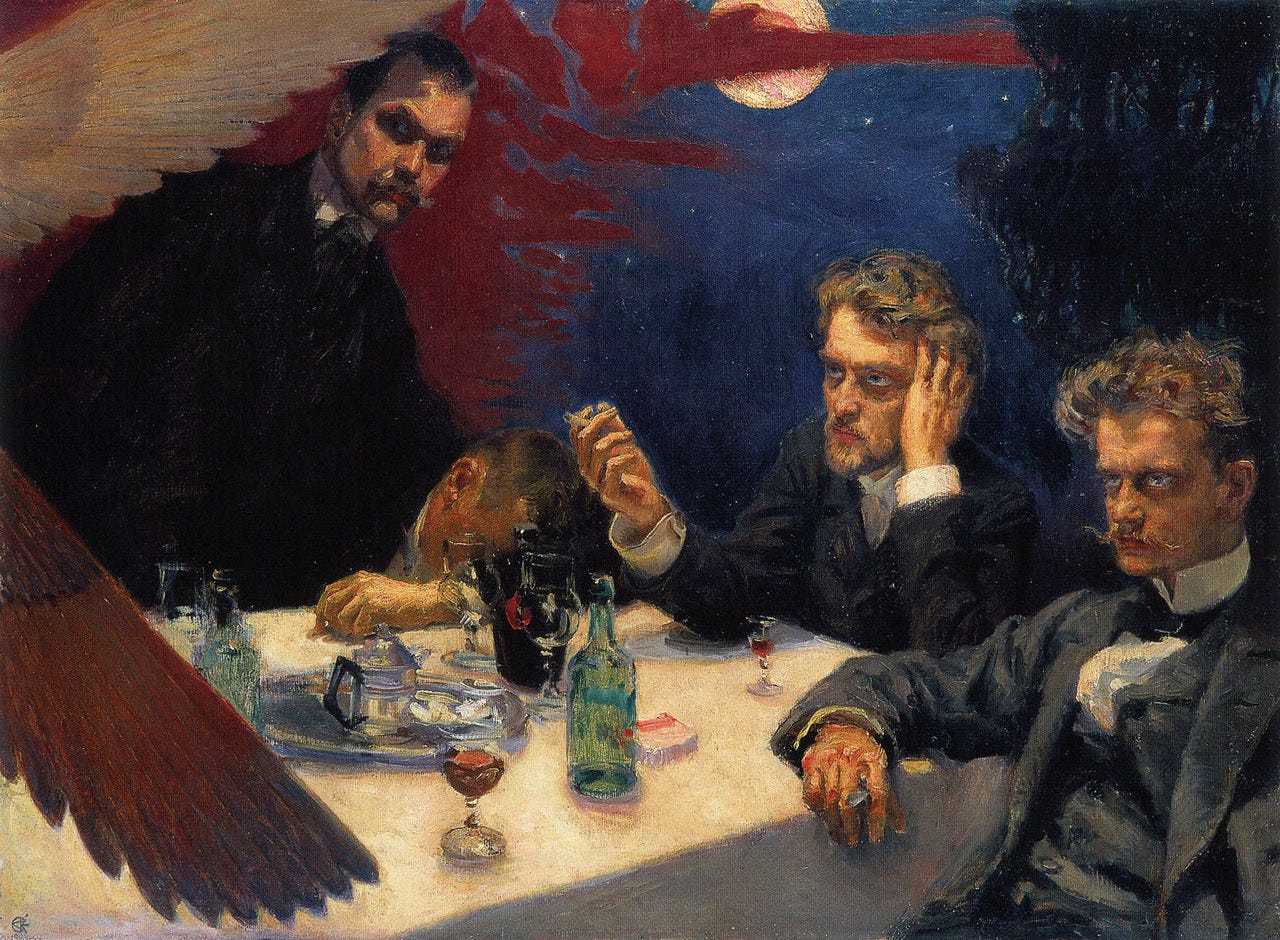
Paris – First of two concerts by Leipzig’s Gewandhausorchester under Andris Nelsons at La Philharmonie de Paris. For the first time in the history of the hall, the seats on the orchestra level had been folded away and replaced with a large block of reasonably priced standing-room tickets. I was surprised by the quality of concentration in that section; I had expected more bustle.
The programme juxtaposed three works by composers strongly associated with countries of the “Other Europe:” after Pärt’s hypnotic Cantus in memoriam Benjamin Britten and a somewhat underwhelming performance of Dvořák’s Violin Concerto by Isabelle Faust, the pièce de résistance was a compelling interpretation of Sibelius’s Symphony No. 2, which Nelsons drove to a triumphal conclusion.
As thematic fragments coalesced into a majestic whole, the expression “order from chaos” popped into my mind. Coincidentally, Ordo ab chao is a well-known Masonic motto. Sibelius, as is well documented, joined the first Finnish Masonic lodge in 1922 a few years after the country gained its independence from Russia. Even though the symphony came much earlier, its sense of struggle resolving into affirmation almost felt like the allegory of a young nation striving to assert its identity.
Wednesday 3 September
Paris – Back to La Philharmonie for a second concert of the Gewandhausorchester led by Andris Nelsons, devoted to Mendelssohn’s Symphony No. 5 and Brahms’s Ein deutsches Requiem, featuring the Chorus of the Orchestre de Paris, Julia Kleiter and Christian Gerhaher. I found myself wondering what had inspired the coupling of two substantial works with unusual religious associations — a Kirchensinfonie and a Requiem that is anything but liturgical.
Nelsons’s backache, already evident the previous evening, had worsened, and he had to prop himself up on a stool to conduct.
The so-called Reformation Symphony left me largely unmoved, but I appreciated the orchestra’s dense textures… and, as a Wagnerophile, I was delighted to hear the ubiquitous Dresden Amen, the liturgical motif written by Johann Gottlieb Naumann (1741–1801) that later resurfaced in Parsifal as one of its most recognisable leitmotifs.
The German Requiem’s fervour was almost mesmeric. Sadly, the Chorus lost steam halfway through, and the somewhat mystical ending lacked the necessary weight.
Thursday 4 September
Paris – Saw Kiyoshi Kurosawa’s 2024 film La Voie du serpent (Serpent’s Path), a French-language remake of one of his own earlier works. A curious choice, though not without precedent in cinema history — Hitchcock, for instance, remade The Man Who Knew Too Much. Hitchcock wanted to refine his film; Kurosawa’s motives seem more elusive.
I had recently discovered Kurosawa through Wife of a Spy (2020), an unexpected delight, but I knew his main body of work belonged to a different register. Viewed as a naturalistic drama, La Voie du serpent is barely watchable; riddled with plot holes and heading toward a denouement obvious within half an hour. Viewed as an offbeat formal exercise, it yields moments of brilliance, but also sags and drags frequently. The off-kilter quality that makes the first half pleasingly freaky soon dissipates, leaving the weaknesses of the project all too exposed.
Friday 5 September
Paris – Back to La Philharmonie de Paris for another chance to hear the Berliner Philharmoniker in Mahler’s Symphony No. 9, only five days after attending the same programme at the Salzburg Festival — and less than four months after Amsterdam.
Kirill Petrenko’s approach let the music speak for itself rather than add extraneous layers of emotion. He drew on the orchestra’s formidable artistry to deliver a taut, transparent reading that emphasised the score’s shifting and frequently devastating moods. I was so caught up I hardly breathed at the end.
And so, for now, the lights dim… until the next act.