

Saturday, August 2nd
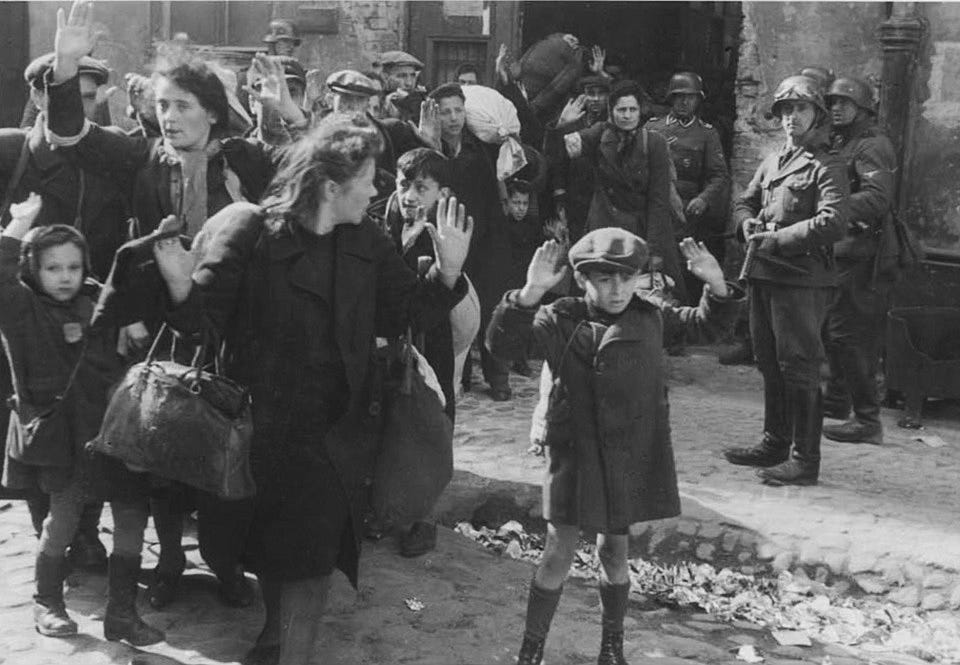
Train to London. On the journey I watched Ingmar Bergman’s Persona (1966), arguably one of his masterpieces. I had seen Ivo van Hove’s stage adaptation in 2022 but was not yet familiar with the original film. One image in particular — the famous 1943 photograph of a young boy being forced out of the Warsaw Ghetto by Nazi soldiers — prompted me to add Susan Sontag’s Regarding the Pain of Others to my reading list.
At the London Palladium, Jamie Lloyd’s much-discussed staging of Evita proved to be an adaptation of his 2019 Regent’s Park Open Air Theatre production. As in his Sunset Boulevard, Lloyd favoured a raw, bare-bones, almost concert-style approach featuring actors well-suited to the approach. I’m not the core audience for this concept, but Evita worked better for me than Sunset Boulevard.
Then on to Milton Keynes to catch the touring production of Calamity Jane, starring Carrie Hope Fletcher. A joyous affair, performed by a gifted actor-musician ensemble — a controversial concept popularised in the 1990s by John Doyle and which, in this case, worked well. My previous encounters with the show had also been in the UK: Toyah Willcox at London’s Shaftesbury Theatre in 2003 and Jodie Prenger in Brighton in 2015. Perhaps the UK has a special affection for Sammy Fain, who always seems to me to lack the recognition he deserves.
Sunday, August 3rd
Flew to Hamburg for my second visit to First Stage Theater, the venue that gives aspiring actors an opportunity to perform before a paying audience. The offering this time was The Prom, the upbeat 2018 Broadway musical, which gained a wider notoriety thanks to the 2020 Netflix adaptation. Not surprisingly, the performances ranged from promising to not-quite-ready — but the enthusiasm was infectious.
Back to Paris by plane.
Monday, August 4th
Paris — On the occasion of its 30th anniversary, the UGC Ciné Cité Les Halles — marketed as Europe’s largest cinema complex with its 27 screens — was running a summer repertory season that included John Cassavetes’ Husbands (1970). Long and messy, yet also brilliant, and powered by the chemistry of Ben Gazzara, Peter Falk, and Cassavetes himself. In an early scene in New York, the three emerge from the 72nd Street Subway station; posters for Schmidt & Jones’ Celebration, the 1969 Broadway musical, appear briefly. A perfect time capsule of the year the film was shot.
Tuesday, August 5th
Paris — Back to Les Halles for Michelangelo Antonioni’s L’avventura (1960), a landmark of modernist cinema. It feels very long, but the cinematography is ravishing and the atmospheric balance of silence, dialogue, subtle background noise and music (a striking score by Giovanni Fusco) works wonders. In the end, I found myself quietly planning a trip to Sicily.
Wednesday, August 6th
Paris — An appropriate day to return to John Hersey’s Hiroshima, the New Yorker’s groundbreaking 1946 feature — at 31,000 words, it filled an entire issue — chronicling the lives of six survivors of the atomic bombing. Hersey’s meticulous approach and his command of language remain mesmerising. Combined with my own visit to Hiroshima in July 2023, a recent viewing of Hiroshima: The Aftermath (Lucy van Beek’s 2015 documentary) and my first encounter, just weeks ago, with Alain Resnais’s 1959 film Hiroshima, mon amour, the effect on me was powerful.
In the last part, following pages upon pages of hurt and desolation, a sudden rebirth:
The bomb had not only left the underground organs of plants intact; it had stimulated them. Everywhere were bluets and Spanish bayonets, goosefoot, morning glories and day lilies, the hairy-fruited bean, purslane and clotbur and sesame and panic grass and feverfew. Especially in a circle at the center, sickle senna grew in extraordinary regeneration, not only standing among the charred remnants of the same plant but pushing up in new places, among bricks and through cracks in the asphalt.
What I wouldn’t give to write half as well…
And so, for now, the lights dim… until the next act.