

Saturday, August 9th
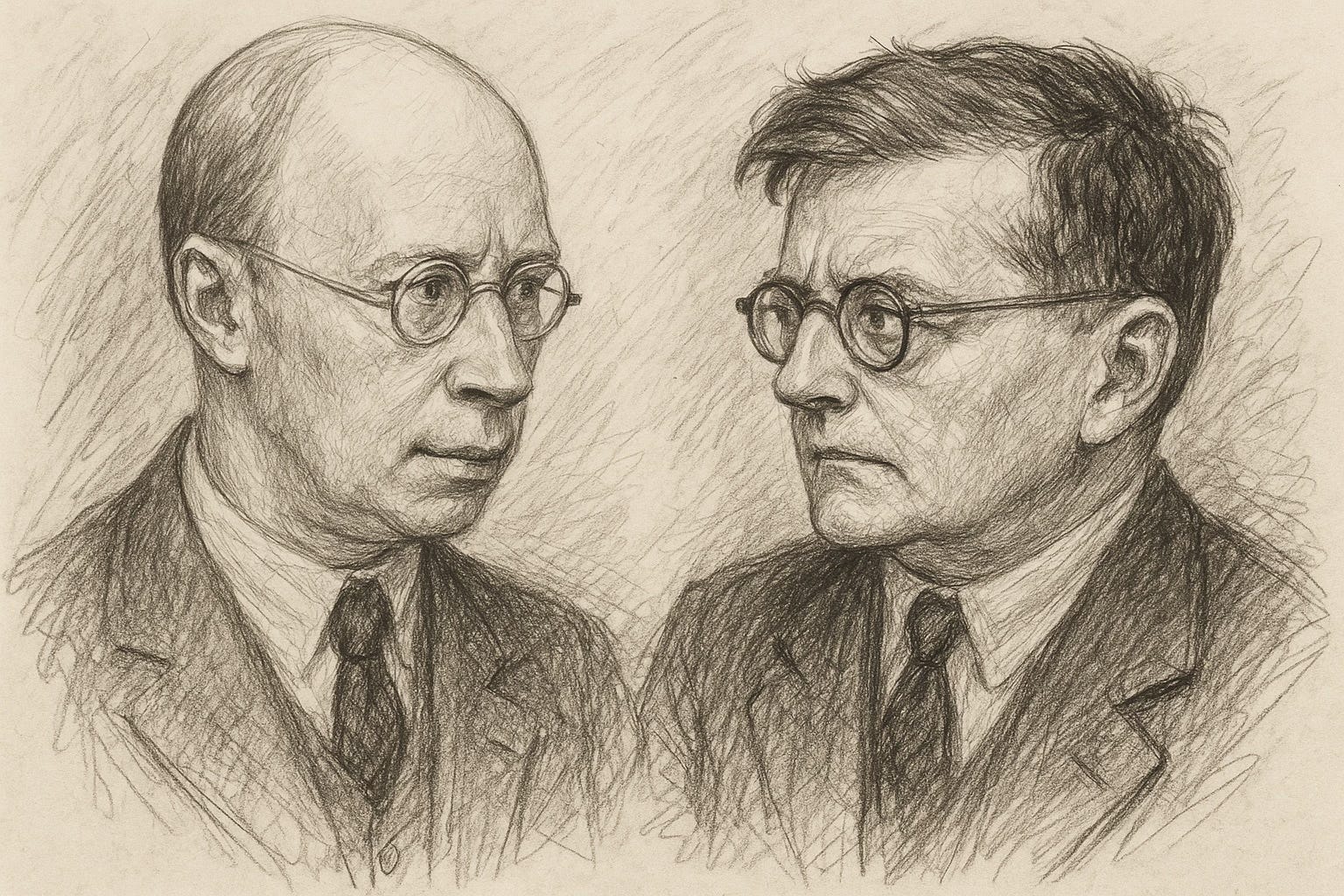
Flight to Vienna. I finished reading Un choix impossible, Dominique Fernandez’s fictionalised biography of Sergei Prokofiev (in French). Prokofiev famously chose to return to the Soviet Union in 1936 after nearly twenty years in exile — unlike Stravinsky, who never returned, and Shostakovich, who never left.
Writing in the voice of Igor, a fictional friend of Prokofiev, Fernandez comments on the composer’s aspirations, conflicts, and creative endeavours. For such an uncompromising personality, having to obey the regime’s diktats must have been deeply frustrating, especially after the notorious 1948 Zhdanov Decree. In the end, Prokofiev resorted to embedding layers of subtext in his scores, à la Shostakovich. Support from rising musicians such as David Oistrakh, Sviatoslav Richter, and Mstislav Rostropovich may have eased the strain.
Prokofiev’s death — on the very same day as Stalin, 5 March 1953 — robbed him of the little public notice his passing might otherwise have received and, more poignantly, of the satisfaction of outliving his tormentor.
The book left me with several avenues to explore, from listening to Prokofiev’s seldom-performed opera The Story of a Real Man to discovering the poetry of Anna Akhmatova.
Vienna — Quick stop at the Albertina. Among the current exhibitions: a retrospective of Brigitte Kowanz’s light-based works, and a survey of the Batliner Collection — now the museum’s permanent collection — spanning Impressionism, Post-Impressionism, German Expressionism, Surrealism, and more contemporary trends. I felt instinctively attracted to Alexej von Jawlensky, an artist I first noticed when his Young Girl with Peonies appeared in the background of a scene in Visconti’s The Damned.
Pause at the museum’s café for a generous serving of Demel’s Kaiserschmarrn.
To Baden bei Wien by train. Once largely dedicated to operetta, Bühne Baden has in recent years diversified into musicals, producing a string of very good productions. The programme of the day was a performance of Chess, the Cold War musical that seems to metamorphose with each staging.
This production was largely faithful to the original 1986 London version, with the addition of a “Budapest prologue.” It was remarkably well conceived and impeccably performed by an orchestra on steroids and a first-class cast: Drew Sarich, who as Freddie delivered a heart-rending “Pity the Child”; Mark Seibert, whose gorgeous voice played against Anatoly’s turbulent emotions; and Femke Soetenga, an imposing presence as Florence. The lycra costumes for the chess-piece dancers might not have been in the best taste.
The show is due for a Broadway revival in the autumn — more than 37 years after its ill-fated original run — and recent semi-staged performances (at the London Palladium and at the Kennedy Center, both in 2018) seem to have confirmed its seaworthiness.
Sunday, August 10th
Early-morning train to Salzburg. The Salzburg Festival was marking the fiftieth anniversary of Dmitri Shostakovich’s death on 9 August 1975.
The performance of the day was “a matinée of Tenths”: the Wiener Philharmoniker under Andris Nelsons performed the Adagio from Gustav Mahler’s unfinished Symphony No. 10, followed by Shostakovich’s own Symphony No. 10. The first echoes the anguish of a man confronting death; the second teems with the complex emotions of a composer reclaiming his voice after years of repression and fear.
The performance was mostly outstanding, from the soul-stirring lament of the violins introducing the obsessive theme of Mahler’s Adagio to the breathtaking finale of Shostakovich’s symphony, which left the audience audibly gasping. At times, though, Nelsons succumbed to his tendency to over-emphasise, adding unnecessary relief to an experience already rich in complexity and texture.
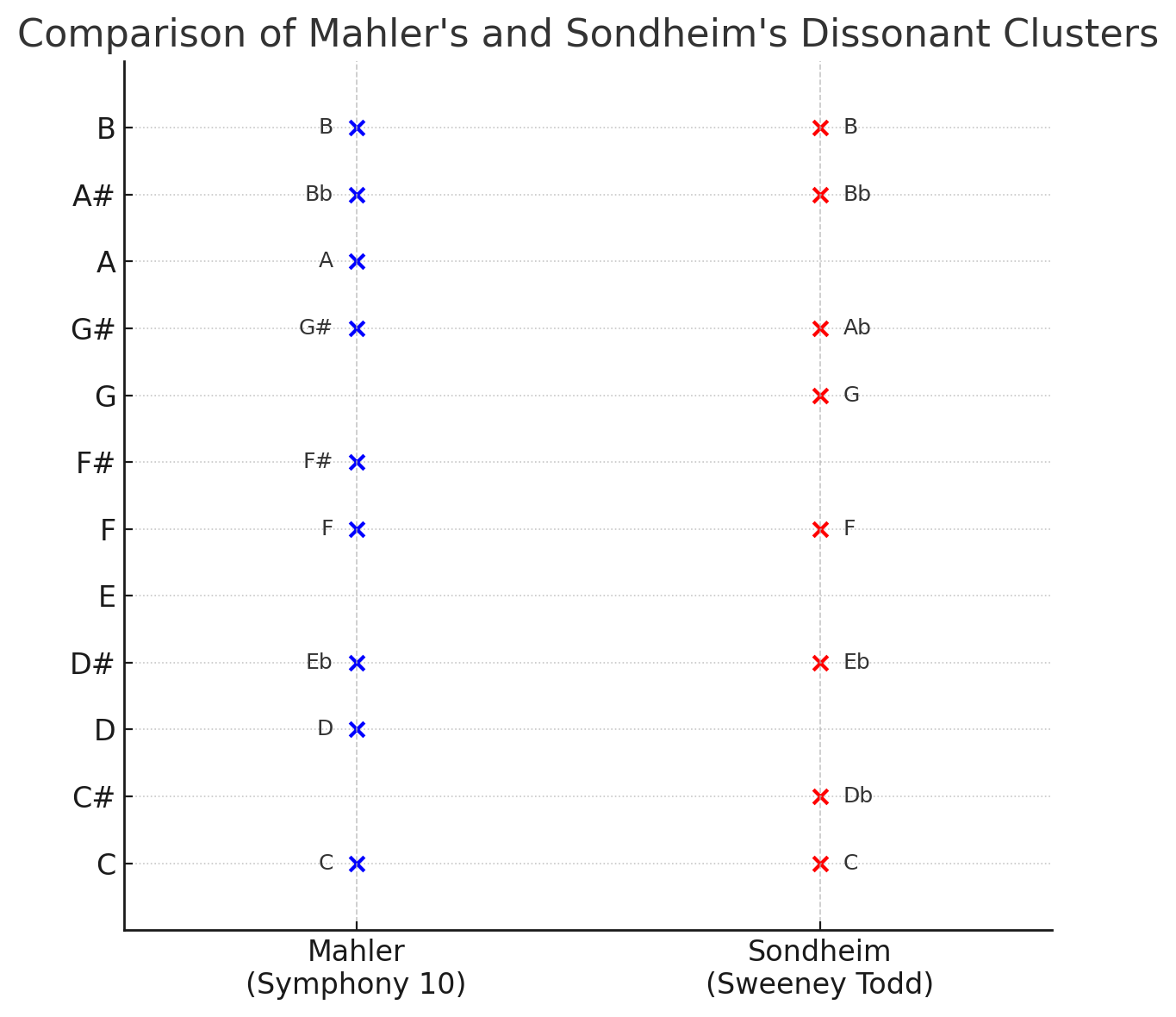
Hearing the nine-note cluster in Mahler’s Adagio reminded me of the dissonant chord at the end of “Epiphany” in Stephen Sondheim’s Sweeney Todd, so I asked an AI to chart them. Both are intensely chromatic and leave little room for breathing.
Train back to Vienna. I watched Kiyoshi Kurosawa’s Wife of a Spy (2020), set in 1941 Kobe. The script focuses on Japan’s territorial expansion during its alliance with Fascist Germany and Italy, and especially on the biological warfare perpetrated by the Imperial “Kwantung” Army in Manchuria — seen through the eyes of a Westernised married couple. Beautifully written, directed, and acted. And because musicals find their way everywhere, Kern and Hammerstein’s “Make Believe,” from Show Boat, plays a key role. (Wagner also makes an appearance with a brief excerpt from Die Meistersinger von Nürnberg heard on the radio.)
Back to Paris by plane.
Monday, August 11th
Paris — Finished reading Julian Barnes’s The Noise of Time, another fictionalised biography, this time of Shostakovich — the one who chose to stay. Not only to stay, but to stay alive.
“From now on there would be only two types of composer: those who were alive and frightened; and those who were dead.”
Barnes examines three key encounters between the composer and “Power,” his term for the Soviet regime: in 1936, when Stalin destroyed the already successful Lady Macbeth of Mtsensk; in 1948, after the Zhdanov Decree, when Shostakovich was sent to the US as a regime propagandist; and in 1960, when he was coerced into joining the Communist Party and becoming an apparatchik — the ultimate indignity.
A quasi stream-of-consciousness technique weaves threads encompassing all that came before and after those milestones, gradually filling in a complete canvas of Shostakovich’s life.
Barnes writes in non-linear bursts, in elegant, economical prose. He crafts sentences that scan like music and are not without irony. His zeugma — “Other members of the delegation, with better seats and greater curiosity, were pressing against the little windows” — recalls Dickens’s “She went home in a flood of tears, and a sedan-chair.”
And so, for now, the lights dim… until the next act.