
Saturday 6 September
To London by train. I first headed to the West End’s Garrick Theatre, where Patrick Marber’s staging of the Mel Brooks musical The Producers had transferred from the tiny Menier Chocolate Factory with much of its original cast. I’ve loved the show since its original Broadway incarnation — an unpretentious yet outrageously funny musical comedy, blessed with a felicitous if somewhat derivative score.
As with earlier Menier shows such as La Cage aux Folles or Sunday in the Park With George, this production was slightly scaled down, and I regretted the loss of a few musical bars — such as the opening vamp of “I’d Like to Be a Producer.” Still, the fun was largely intact, even at times sharpened by Marber’s touches. The flute remained a beguiling thread in the orchestrations, to my great delight.
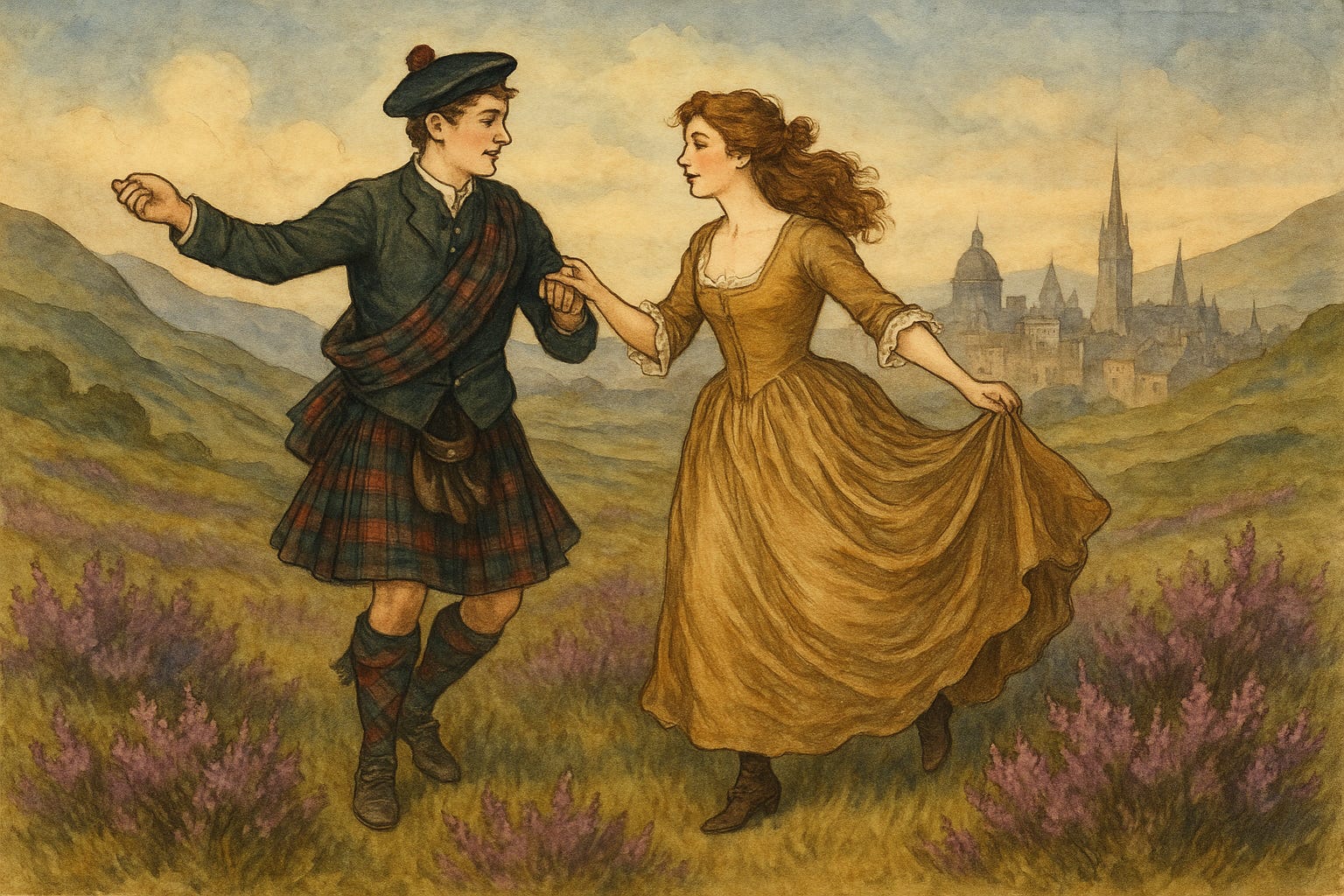
Next to Regent’s Park Open Air Theatre. The original 1947 production of Lerner & Loewe’s Brigadoon was a hit not only because it stood alongside Rodgers & Hammerstein’s Oklahoma! And Carousel in shaping the modern integrated Broadway musical, but also because Agnes de Mille’s choreography transformed it into a true dance-driven musical play. It is therefore fitting that subsequent revivals, like the one I attended at Chicago’s Goodman Theatre in 2014, have often been entrusted to directors-choreographers.
So it was with this staging, directed and choreographed by Drew McOnie, who brought an acute sense of visual gravitas and fluidity to the show’s many ballets.
Did the rest measure up? The new book, by Rona Munro, reimagined the two American protagonists as stranded Second World War airmen, largely to draw parallels with the Anglo-Scottish conflicts of the 18th century, the reason why Brigadoon’s people are supposed to have bargained peace at the cost of being suspended in time. To me that change neither harmed nor enhanced the original.
The set looked like it had been recycled from last year’s Fiddler on the Roof, while the costumes relied on a cloying colour palette that suggested Barbie more than the Highlands. More frustrating was the prominence of vocally average singers in a cast clearly chosen for their dancing chops. A respectable artistic decision, but also one that contributed to paying insufficient homage to Lerner & Loewe’s classic score.
Sunday 7 September
Back in Paris – Visited the in-situ installation of Wolfgang Tillmans’s works at the Centre Pompidou. The Museum was two weeks away from closing its doors for at least five years and it already took the air of a ghost ship. The last space open to the public used to house the Centre’s Library, known as the Bibliothèque publique d’information. A few remnants — shelves, books, signs, computer stations — acted as portals to the past, and Tillmans was given carte blanche to make the space his.
Tillmans deployed a mismatched, slightly haphazard assortment of photographs, films, paintings, collages, and other works throughout the venue, right into every nook and cranny, building a highly personal, site-specific installation and made the place his, even sonically. I could have spent hours exploring the many minute, unexpected details… which for some reason reminded me vaguely of Punchdrunk’s site-specific theatrical experiences.
I then saw Exit 8, Genki Kawamura’s intriguing Japanese film — apparently based on a video game — about characters striving to find the elusive exit of a subway station. The film is not without faults, but I found myself engaged by its polished, almost stylised visuals — which are somewhat reminiscent of Kubrick. The soundtrack makes great use of Ravel’s Bolero.
Tuesday 9 September
Finished reading Dino Buzzati’s surrealist 1940 novel Il deserto dei Tartari (in French), which I may or may not have encountered as a teenager. Its theme of endlessly deferred expectations resonated strongly, and I was struck by Buzzati’s gift for conjuring the absurd yet highly regulated, at once spacious and claustrophobic, world of the Bastiani Fort in such vivid detail… a setting which reminded me of the impossible constructions of Escher, whose drawing haunts Exit 8.
Wednesday 10 September
Paris – Attended a concert by the Wiener Philharmoniker under Franz Welser-Möst at the Théâtre des Champs-Élysées: Mozart’s Symphony No. 38 followed by Tchaikovsky’s Symphony No. 6. The older I get, the wearier I get of such couplings, and I would be hard pressed to find a compelling reason to place those two symphonies on the same programme.
Both left me largely unmoved, owing to a deliberately stripped-down approach: little resonance, a dry sound, and needless attempts at showy virtuosity in fast movements taken at breakneck speed. In the end, Welser-Möst’s reading failed to touch the music’s soul, a paradoxical feat, at least in the case of the Pathétique, which wears its heart on its sleeve.
Thursday 11 September
Paris – The Orchestre de Paris and its musical director Klaus Mäkelä selected an exhilarating programme for the season’s opening concert. The French premiere of Guillaume Connesson’s Danses concertantes, a concerto for flute and orchestra, came across as somewhat more traditional than the rest of the programme, consisting of 20th-century works brimming with modernist energy. Still, it bewitched the audience with its unique blend of dance rhythms and shifting atmospheres, giving Principal Flute Vincent Lucas — a long-standing member of the Orchestre de Paris — an ideal showcase.
Echoing Copland’s solemn, monumental Fanfare for the Common Man, which opened the evening, the second half began with Joan Tower’s Fanfare for the Uncommon Woman No. 1, a witty rejoinder composed more than forty years later.
Another striking mirror effect arose from the juxtaposition of Gershwin’s An American in Paris and Varèse’s Amériques. Although Gershwin’s jazz-inflected symphonic poem and Varèse’s uncompromising modernism belong to very different idioms — and even though Varèse insisted his intent was metaphorical rather than literal — the two works, written less than a decade apart, seemed to answer one another across the Atlantic. Beyond Gershwin’s taxi horns and Varèse’s sirens lies a shared sense of excitement: the thrill of novelty, the intoxication of possibility.
Mäkelä coaxed the orchestra into a freer, almost swinging sound. The enthusiasm, as always, proved infectious.
Friday 12 September
Paris – One day after the Orchestre de Paris opened its season with Copland’s Fanfare for the Common Man, the Orchestre Philharmonique de Radio France chose Shostakovich’s Festive Overture for its own inaugural concert, conducted by Santtu-Matias Rouvali at the Auditorium of the Maison de la Radio et de la Musique. Commissioned for the Bolshoi Theatre’s celebration of the 37th anniversary of the October Revolution in 1954, it appeared as a jaunty, exuberant “Soviet” counterpoint to Copland’s solemnity. It was followed by a stark account of Shostakovich’s Violin Concerto No. 2, whose sinister, rasping shadows found a gripping interpreter in Leonidas Kavakos.
A central section coupled two choral works by Philippe Hersant: In diebus nostris — receiving its world premiere — and Psaume 121, written for the 850th anniversary of Notre-Dame de Paris in 2013 and originally scored for three choirs (!), two organs (!!), and a small assortment of rare baroque wind instruments. Both were conducted by Lionel Sow, dedicatee of In diebus nostris.
The evening closed with Saint-Saëns’s Symphony No. 3, given here in an understated yet eloquent reading that Rouvali drove to a buoyant conclusion. Throughout, principal oboe Olivier Doise stood out for his charisma and commitment.
And so, for now, the lights dim… until the next act.