
Saturday 23 May
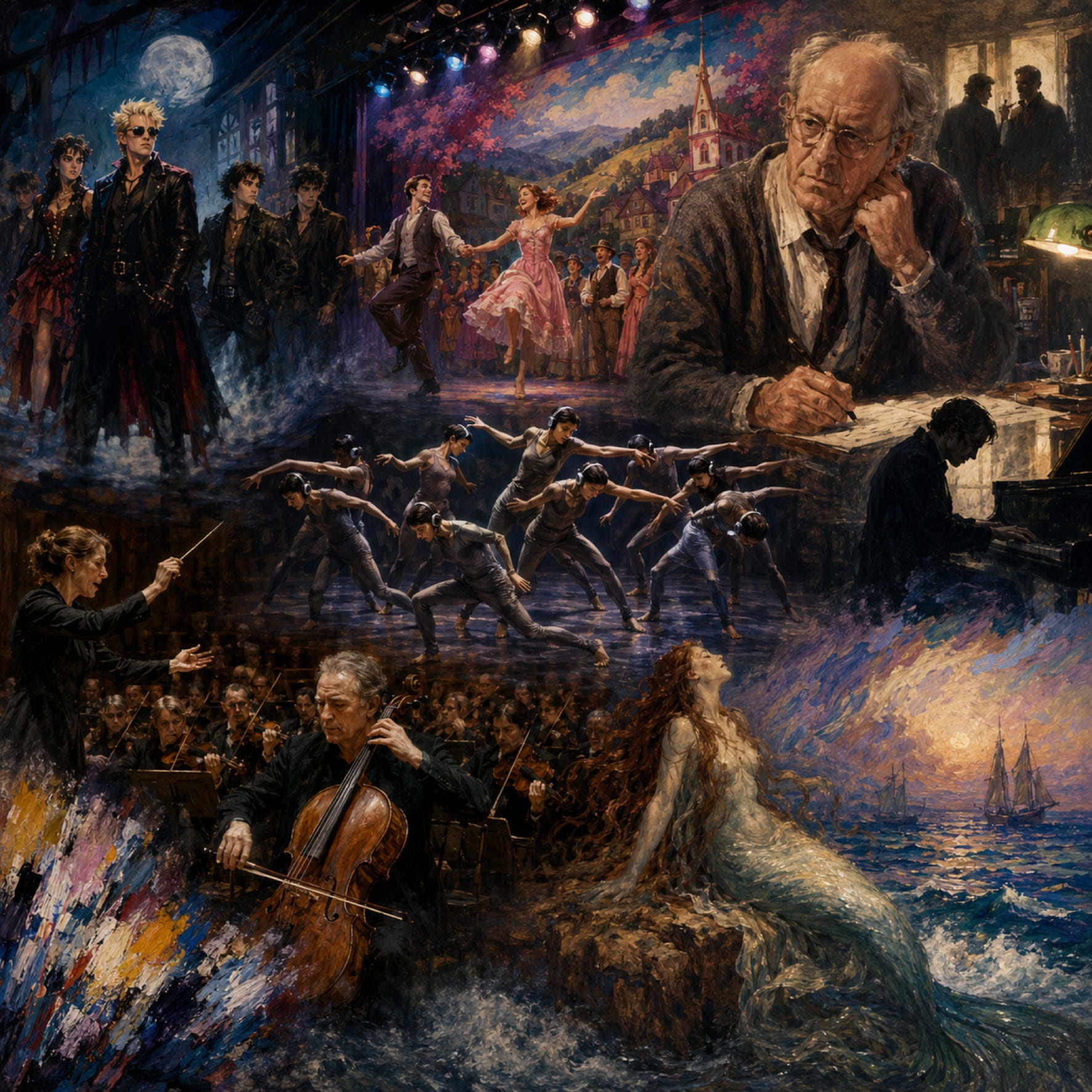
New York, Palace Theatre • The Lost Boys, like Beaches, was based on a 1987 film, but the similarities largely ended there. A story of vampires taking over a Californian city sounds like an unlikely candidate for a musical, and yet the creative team came up with a finely crafted theatrical object: the wonderful scenic design by Dane Laffrey enabled exquisitely fluid, eye-popping transitions; the ambitious score by the pop band The Rescues rose well above banality; and a committed, charismatic cast sold the show with gusto.
New York, Music Box Theatre • Like Nixon/Frost, Oslo or Good Night, and Good Luck before it, Giant relied on a historical episode — in this case, the aftermath of a controversial 1983 book review written by children’s literature maverick Roald Dahl — to examine remarkably resonant issues in a superbly crafted, nuanced and dramatic manner. John Lithgow, unsurprisingly, gave a towering performance as the British author. He also seemed to act as a catalyst for the rest of the company, who rose to meet his exceptional standard, the resulting ensemble performance serving as a reminder of theatre’s transformative power.
Sunday 24 May
New York, Nederlander Theatre • I approached Schmigadoon with caution, expecting to find it cringeworthy, and yet I ended up buying into its questionable concept of paying homage to the musical theatre form by satirising it. Even though it worked for me, I couldn’t help thinking that audiences with limited familiarity with the Golden Age of musicals would probably miss both the homage and the satire, leaving the show to be judged solely on its mediocre music and lyrics. Christopher Gattelli’s direction and choreography likely did much to find the narrow ridgeline that kept the performance from plunging into the abyss. A temporary tonal shift into Sondheim territory in the second act may have been the wink too many, though.
Back to Paris by plane
Monday 25 May
Paris, Théâtre de la Ville · In Christos Papadopoulos’s My Fierce Ignorant Step, ten dancers performed elemental movements in near-synchronicity, subtly raising questions about the interdependence between a moving whole and its parts. The dancers’ ability to memorise an hour’s worth of seemingly Brownian motion, not to mention their physical endurance — they never stopped moving throughout the performance — amazed me. I found myself wondering whether the headsets they wore provided some form of guidance.
Wednesday 27 May
Paris, Philharmonie de Paris · After yet another instalment of Joan Tower’s Fanfare for the Uncommon Woman (No. 6, this time, strangely arranged for solo piano), the Orchestre de Paris took on Dvořák’s Cello Concerto (with Truls Mørk) and Tchaikovsky’s Symphony No. 5 under Anja Bihlmaier’s stewardship. The chamber music-inspired approach to the concerto resulted in a beautifully balanced and illuminating performance. A remark by K. about Dvořák’s connection with Victor Herbert also led me to discover the extent of the friendship between the two men. Alas, what had worked so well in the concerto proved far less convincing in the symphony, stripping the music of much of its character while highlighting Bihlmaier’s unfortunate tendency to rush the major tutti climaxes.
Thursday 28 May
Paris, Auditorium de Radio France · My giddy anticipation at hearing Zemlinsky’s shimmering Die Seejungfrau performed by the Orchestre National de France under Thomas Guggeis quickly turned to disappointment. The performance felt stiff and directionless, draining the score of much of its sensuality and sweep. The addition of a wholly superfluous narration only made matters worse, disrupting the work’s natural flow. The evening’s saving grace proved to be Patrick Pleutin’s live paintings, which restored some of the fluidity and sense of wonder too often absent from the performance.
Friday 29 May
Paris, Philharmonie de Paris · With subdued authority — and not a score in sight — Daniele Gatti led the Staatskapelle Dresden in a programme bracketing two French turn-of-the-century works, Saint-Saëns’s Cello Concerto No. 1 (with the ubiquitous Gautier Capuçon) and Debussy’s La Mer, with Wagnerian orchestral staples: the Meistersinger Overture, the Prelude to Tristan und Isolde, and Isolde’s Liebestod. The Wagner excerpts displayed the self-assurance of an orchestra from a city that can justly claim to have been Wagner’s artistic cradle. The musicians seemed less instinctively at ease in the French repertoire, however. La Mer’s shifting colours and elusive textures felt oddly earthbound.
And so, for now, the lights dim… until the next act.