
Saturday 31 January
To Dresden by plane and train
Dresden, Semperoper • I’d been without my beloved Dialogues des Carmélites for a little over a year. The reunion was all the more potent as this production proved successful on every front: simple but forceful visuals, intense, dramatic orchestral playing under Marie Jacquot, and a cast that kept the French libretto largely intelligible. There have been numerous ways of representing the Carmélites’ deaths in the final scene. By having each of them cross out her name from the wall on which the revolutionaries had scrawled the list of the condemned sisters, director Jetske Mijnssen chose an option as efficient as it was economical — effacement of martyrdom over spectacle.
Sunday 1 February
Back to Paris by train and plane
Monday 2 February
Paris, Philharmonie • Polish pianist Piotr Anderszewski combined a selection of Brahms’s pieces from opp. 116 to 119 with Beethoven’s formidable last sonata (No. 32, op. 111). He approached these staples of the repertoire with maturity and assuredness, imprinting a distinctive yet entirely convincing mark — not least through the way he reordered the Brahms pieces into a sequence that clearly made sense to him, while straying from their catalogue order. In Beethoven, Anderszewski brought out unusual inner voices and, like Jonathan Biss a few weeks earlier, emphasised the striking rhythms of what I now officially describe as “the honky-tonk section” with blissful abandon.
Wednesday 4 February
Paris, Philharmonie • Semyon Bychkov led the Orchestre de Paris in a majestic programme consisting of Tchaikovsky’s Piano Concerto No. 1 (with Kirill Gerstein) and Strauss’s An Alpine Symphony. Bychkov was the orchestra’s musical director from 1989 to 1998, and there were probably a few musicians still on stage from that period — or even players he had hired himself. The alchemy felt powerful, all the more as Bychkov is one of those conductors who seem to achieve an almost mystical authority in their mature years. Gerstein gave a fluid performance of the Tchaikovsky, while the orchestra winningly conjured the epic proportions and rapidly shifting light of Strauss’s symphony.
Thursday 5 February
Paris, Fondation Louis-Vuitton • A retrospective exhibition of German painter Gerhard Richter once again impressed me by the breadth of the body of work on display. Richter’s journey from blurred versions of real-life scenes to full-blown abstraction and back was charted with just the right dose of pedagogy. My brain somehow decided that works based on real images, even if deformed beyond recognition by knives and scrapers, held greater fascination than fully abstract subjects, which ended up looking too similar for comfort. I regretted not trying to follow Richter’s traces in his native Dresden when I was there a few days earlier, especially the mural he painted for the Deutsches Hygiene Museum — although it appears to be in the process of being partially uncovered and restored after being painted over.
Paris, Fondation Louis-Vuitton (again, later) • Pascal Dusapin’s To Be Sung is described as an opera that “forsakes all dramaturgy and action.” In other words, it’s anything but an opera. Which doesn’t mean it isn’t an original, engaging musical object, making singular use of Gertrude Stein’s assonant, patterned prose. Le Balcon under Maxime Pascal, together with a narrator and a trio of sopranos, gave it a dreamlike texture — somewhat echoing Philip Glass’s Einstein on the Beach with its obsessive repetitions. Pharrell Williams’s “set design and lighting” are probably best left uncommented.
Friday 6 February
To Amsterdam by train
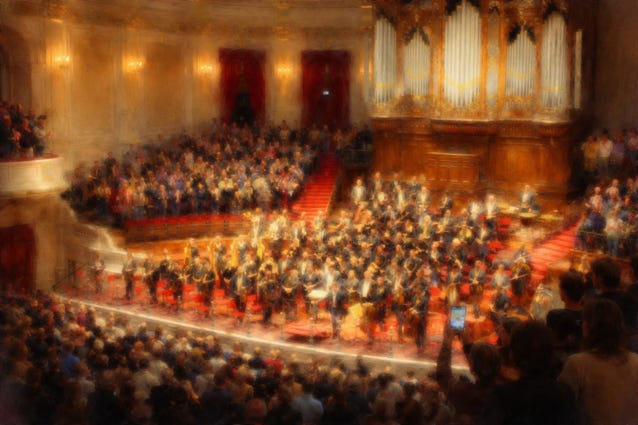
Amsterdam, Concertgebouw • Klaus Mäkelä led Amsterdam’s Concertgebouworkest in a tight yet lyrical account of Bruckner’s Symphony No. 8. Adopting deliberately slow tempos, Mäkelä emphasised melodic lines and maintained transparency throughout. The Scherzo’s Trio took on an ethereal hue, the harps sounding like greetings from another world entirely. The orchestra remained fully committed till the last note, and the fourth movement built up exultantly to one of the most enjoyable resolutions of the classical repertoire.
And so, for now, the lights dim… until the next act.