
Saturday 14 February
To Osaka by train
Umeda Arts Theater, Osaka – Maury Yeston’s latest show, Issa in Paris, had just premiered in Tokyo, and an opportunity arose to see it in the second of its three-city tour, in Osaka.
Thankfully, there was enough material online to make sense of the convoluted plot. A modern-day singer, Kaito, who goes by the stage name ISSA and whose hit song is titled “Talk, Talk, Tokyo,” strives to get out of a creative and personal impasse involving childhood traumas by following in the footsteps of Kobayashi Issa, one of Japan’s most famous haiku poets, also the academic specialty of his recently-deceased mother. 18th-century Issa (born Yatarō in Nagano), left an unexplained ten-year gap in his biography from 1777 to 1787. The show assumes some Dutch sailors he met at a Nagasaki whorehouse where he worked offered him passage to Europe, where he somehow made his way to Paris. Modern-day Kaito, equipped with his mother’s work, also travels to Paris (albeit by plane) and falls in love with a young woman who introduces him to an activist, pro-social justice movement — while his past counterpart lands in the midst of the French Revolution and falls for lovely Thérèse, never parting with his Japanese sandals. Both Issas somehow return home with their artistic energies renewed and their personal turmoils appeased.
It would be unfair to judge a show in a language I don’t understand. On the one hand, the somewhat clichéd second act failed to fulfil the expectations raised by the show’s intricate, if somewhat overwrought, exposition. On the other hand, the show had some strong redeeming features. The score, for one, although derivative at times, adopted a wide range of styles — from pentatonic-sounding songs for 18th century Japan to rap for modern-day French protesters. Even though the time came for the inevitable revolutionary song, a mix of Les Misérables and Billy Elliot complete with drums, piccolo and muted trumpets, there were many delightful moments of charming melodic, rhythmic and harmonic inspiration — not least of which what might be the most tender brothel song ever written.
The staging relied on a nifty modular set that sometimes seemed to be entrusted with a choreography of its own. Together with sophisticated projections and lighting effects, it created a fluid series of striking images, imposing visual coherence on the show’s complex chronology.
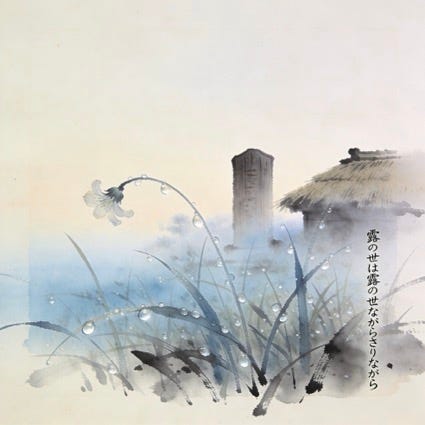
The show started with one of Kobayashi Issa’s most famous haikus, written on the occasion of a child’s death:
This world of dew
is a world of dew,
and yet, and yet…
露の世は露の世ながらさりながら
A potent reminder of the emotional force of that quintessentially Japanese art form — however much may be lost in translation.
Back to Tokyo by train
Sunday 15 February
Suntory Hall, Tokyo • On the eve of his ninetieth birthday, conductor Eliahu Inbal led the Tokyo Metropolitan Symphony Orchestra in a powerful yet impeccably shaped account of Mahler’s monumental Symphony No. 8. The hall’s acoustics seemed overwhelmed by the sheer weight of sound, but Inbal’s interpretation, informed by a lifetime immersed in Mahler, proved precise, demanding and remarkably nimble. The spatial effects, with the extra brass and the Mater gloriosa performing from the balcony, were exquisitely immersive. Outside the hall, balloons were already in place for the next day’s celebration.
Back to Paris by plane
Monday 16 February
Paris, Théâtre de l’Athénée • Drawing from a wide repertoire ranging from German lieder to American musicals, singers Fleur Barron and Axelle Fanyo, together with pianist Julius Drake, assembled a programme of songs framed around Catholicism’s seven deadly sins. I had heard the same artists in far more focused programmes in Amsterdam at the 2025 Mahler Festival. This new venture, as refreshing as it looked on paper, felt contrived. The performers seemed unsure how to endow each piece with its distinct colour, at times semaphoring emotions rather than inhabiting them and occasionally betraying discomfort in the syncopated passages.
Wednesday 18 February
Paris, Philharmonie de Paris • Paavo Järvi led the Orchestre de Paris in a splendid programme pairing a heartfelt account of Elgar’s Cello Concerto, played by Sol Gabetta, with a lyrical yet incisive reading of Bartók’s Concerto for Orchestra. The orchestra appeared uncannily in tune with its former music director, each section intent on sustaining the exquisite tension circulating through the phalanx. The contemporary work opening the evening, Helena Tulve’s Wand’ring Bark, felt like a collage of textures and gestures familiar from countless contemporary scores.
Thursday 19 February
Paris, Théâtre national de Chaillot • Japanese choreographer Saburo Teshigawara devised a one-hour visual meditation on Tristan and Isolde, set to excerpts from Richard Wagner’s score. Together with fellow dancer Rihoko Sato, he created a sequence of striking images, sculpted through dramatic poses and silhouettes etched against meticulously calibrated lighting. Despite the obvious amount of creativity, I failed to be carried away by an endeavour that felt more constructed than lived.
Friday 20 February
Paris, Théâtre de la Ville • A German-language production of Bertold Brecht’s Der kaukasische Kreidekreis by the Berliner Ensemble played the Festival international de Paris in 1955, to critical acclaim. More than 70 years later, Emmanuel Demarcy-Mota offered a contemporary take, titled Le Cercle de craie caucasien, in a French translation by Georges Proser, in the very same theatre — now the Théâtre de la Ville. Despite the play’s sustained relevance to our times and Demarcy-Mota’s strong visual chops, the performance felt overlong to me, with the titular chalk circle appearing only in the final fifteen minutes.
And so, for now, the lights dim… until the next act.